This travel update is part one of our ten-day stay in Copenhagen, Denmark. It covers October 9 – 12. “Any text in quotes and Italics has been copied and pasted from some informational website like Wikipedia.”
October 9, 2023 – Monday: Riding the Train from Stockholm to Copenhagen
We were up by 4:30 AM this morning for our trip to Copenhagen. After packing up, we walked a few blocks and caught a tram that took us to the subway. The subway took us to T-Centralen, the main train station of Stockholm. Patti got a cinnamon roll and a cardamom roll at one of the bakeries at the station then we located our platform. Here’s Patti in the platform waiting room.
“Cardamom, also spelled cardamon, is a spice consisting of whole or ground dried fruits, or seeds, of Elettaria cardamomum, a herbaceous perennial plant of the ginger family. The seeds have a warm, slightly pungent, and highly aromatic flavor. They are a popular seasoning in Scandinavian pastries.“

“I’m sittin’ in the railway station got a ticket for my destination…” That’s a line from an old Simon and Garfunkel tune that seems appropriate here.
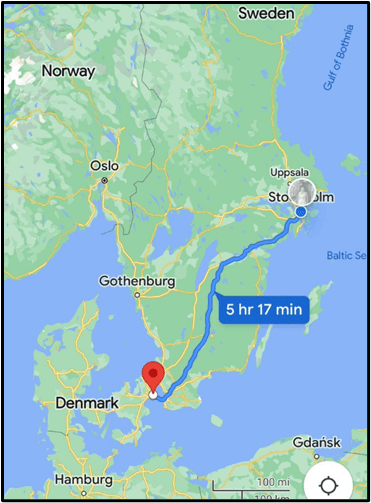
Our route today was pretty straight-forward, south and west to Copenhagen.
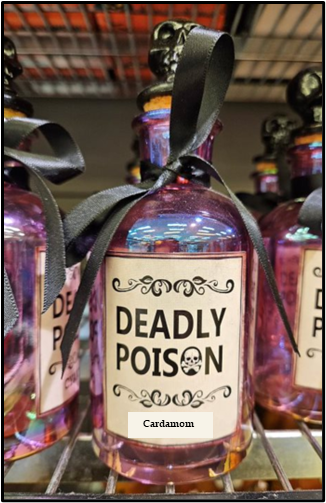
On the train ride Patti experienced a bit of motion sickness, she said says she believes she was poisoned by the cardamom roll. She was able to vomit discretely into one of the plastic bags that are supplied and then she felt better.
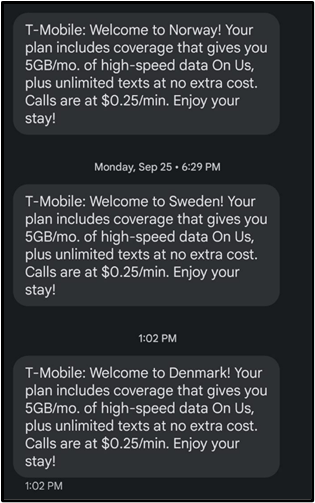
After the train crossed the long bridge from Sweden into Denmark, we both received the standard notice from T-Mobile welcoming us to a new country. I saved the ones from Norway and Sweden too.
After crossing the bridge, the train goes directly into a tunnel. I retrieved the top picture from the internet and Patti took the bottom picture while we were out on our run / jog yesterday.
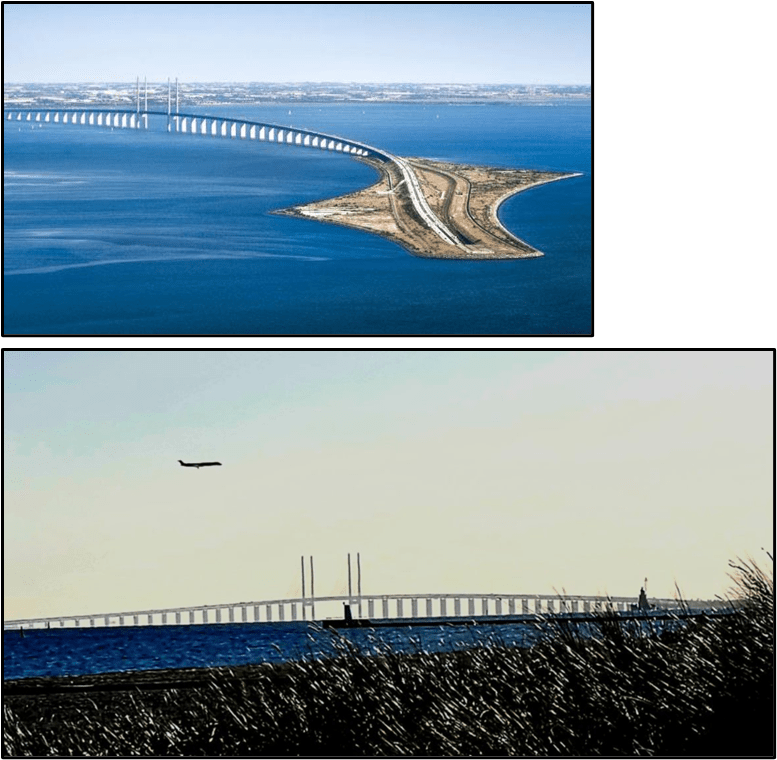
“The Øresund or Öresund Bridge is a combined railway and motorway bridge across the Øresund strait between Denmark and Sweden. It is the longest in Europe with both roadway and railway combined in a single structure, running nearly 8 kilometres (5.0 miles) from the Swedish coast to the artificial island Peberholm in the middle of the strait. The crossing is completed by the 4-kilometre (2.5 mi) Drogden Tunnel from Peberholm to the Danish island of Amager.”
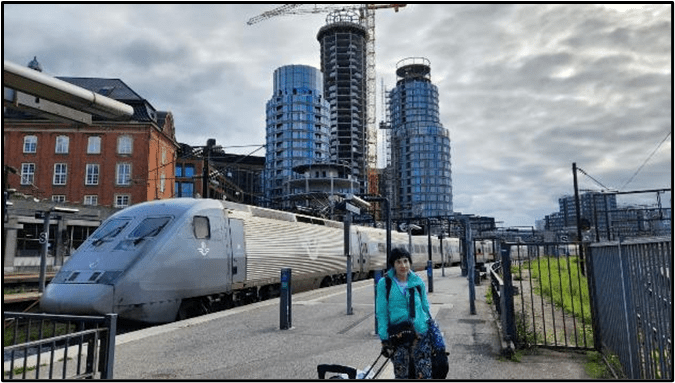
The train platform in Copenhagen was actually outside the main building. Here’s Patti on the platform. It wasn’t raining and it was warmer than Stockholm, which made us happy.
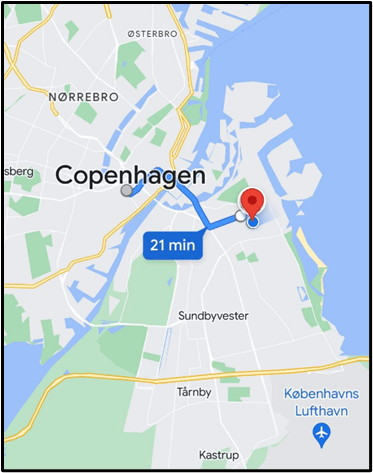
Google Maps showed us a recommended route to the Airbnb — a ten-minute bus ride combined with a ten-minute walk.
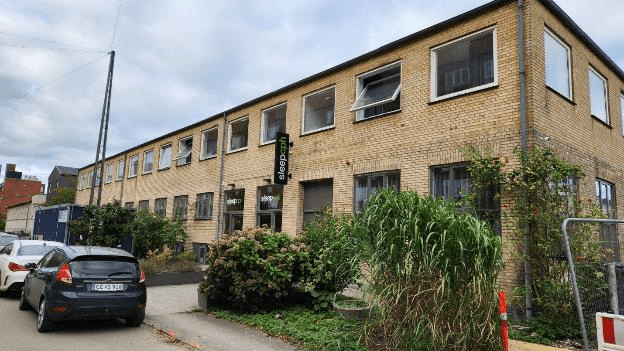
The neighborhood where we are staying is called Amager. This Airbnb is a “managed apartment” with a company called “sleepCPH” — below is a picture of the outside of the building.
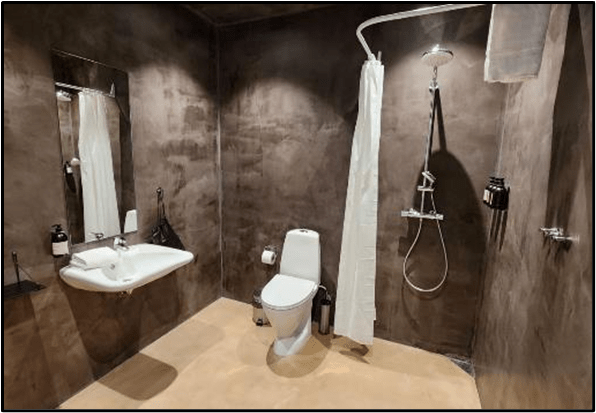
We have a dedicated access code for the lobby door and for our apartment door. This apartment is shaped like a U. When you walk in there’s a hallway with the bathroom on the left.
The bathroom is roomy. The shower is typical of what we’ve seen in Scandinavia. There’s a drain in the corner and a shower curtain you can close to keep most of the spray from spreading around the bathroom. We bought a squeegee so we can move the water towards the drain after a shower.
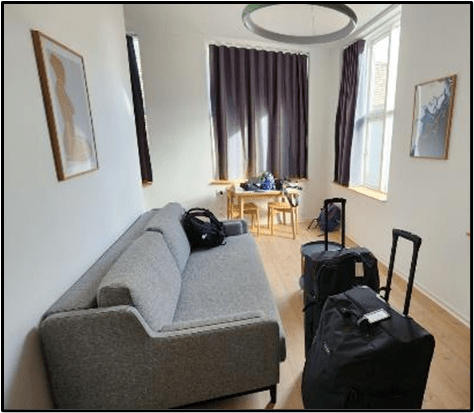
Continuing through the apartment you get to the living room / dining room.
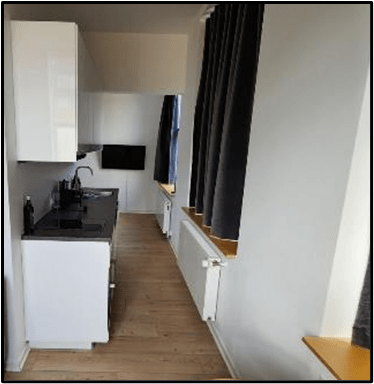
Turn left at the dining table and you get to the kitchen.
Turn left past the kitchen to get to the sleeping area. Throughout our travels in Norway, Sweden and Denmark, the cable service has included a number of channels from the United States, such as CNN, NBC, Reuters and Bloomberg, as well as The History Channel and MTV, to name a few. In addition, there is always a channel that runs marathon viewings of Baywatch — Baywatch is popular in Europe!!!
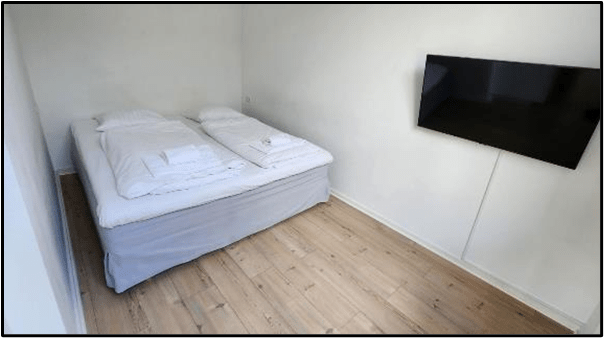
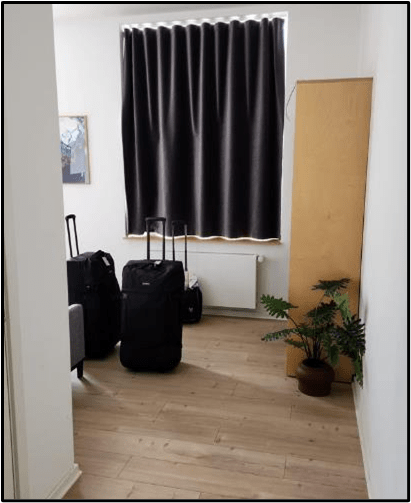
The place is sparsely decorated which suits us fine, there’s plenty of room for our stuff.
After unpacking, we went to the Coop365 grocery store located nearby. Later we walked around the building to explore the “lay of the land” and to find the laundry room. Shown below is a picture of the building layout. Our room is at the top right with blue circle around it. It looks like we have the largest apartment in the building.

Many of the rooms here are small rooms with a bed and probably a table and chair. There are 10 communal toilet/shower rooms and a large communal kitchen and a laundry room. We have our own bathroom and kitchen, but we’ll use the laundry room. My guess is that a lot of people staying here save money by sleeping in a small room with a bed then using the communal bathrooms and kitchen.
October 10, 2023 – Tuesday: A Copenhagen City Walk
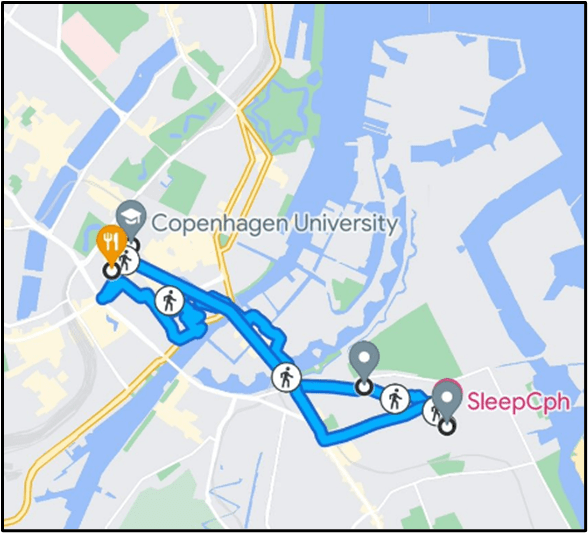
We slept late this morning then headed out around 11:00 AM to explore some of Copenhagen. Google Maps recorded this route of our walk today. We walked about eight miles.
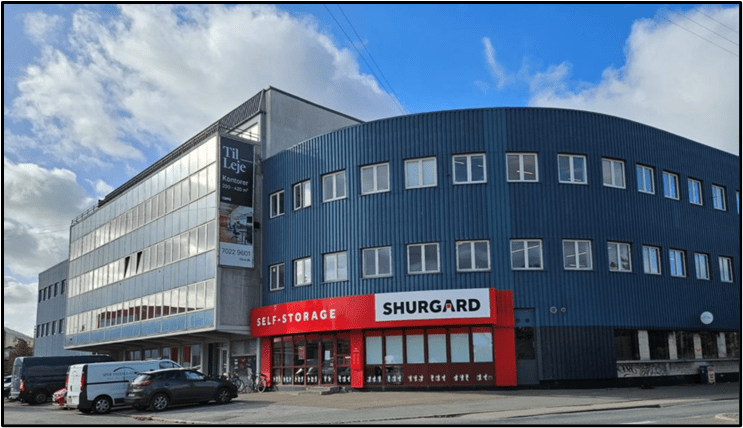
About five minutes after leaving our Airbnb, we walked through a commercial/industrial area and walked past this building. Similar to the United States, Denmark has self-storage facilities. We also saw self-storage facilities in Norway and Sweden.
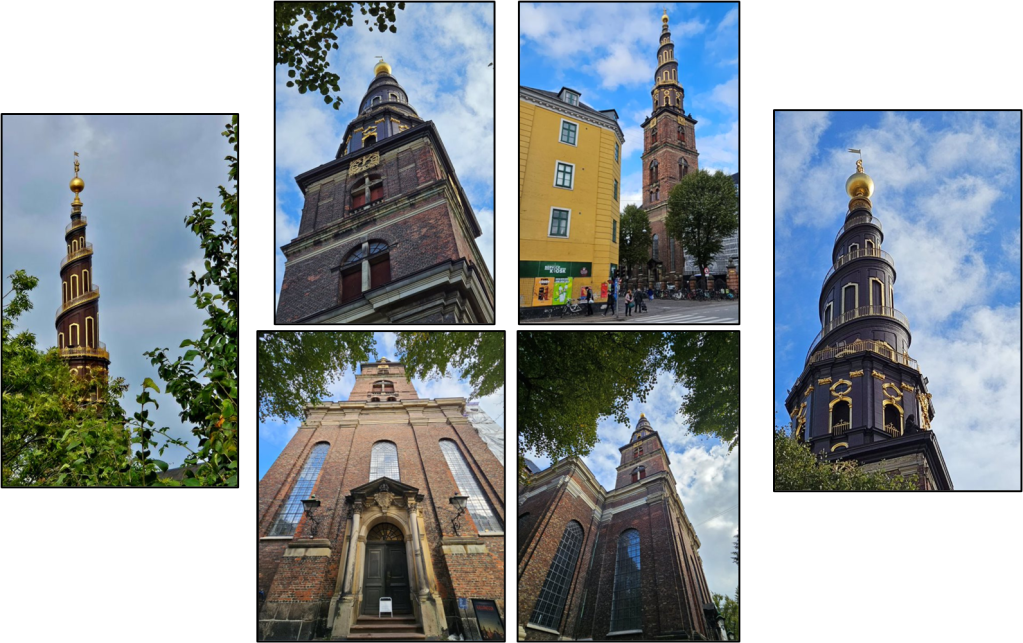
Shortly after that, we crossed a bridge into Christiania and spied a magnificent spiral spire of a church. Unfortunately, renovations are going on at this church, so we weren’t able to go inside or take the stairs up the tower to the top.
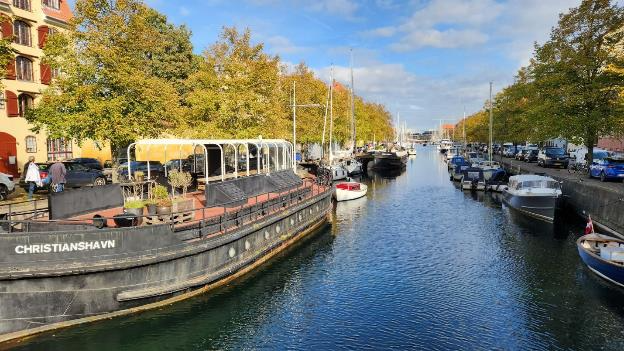
Then we crossed overt our first Copenhagen canal, which was very pretty.
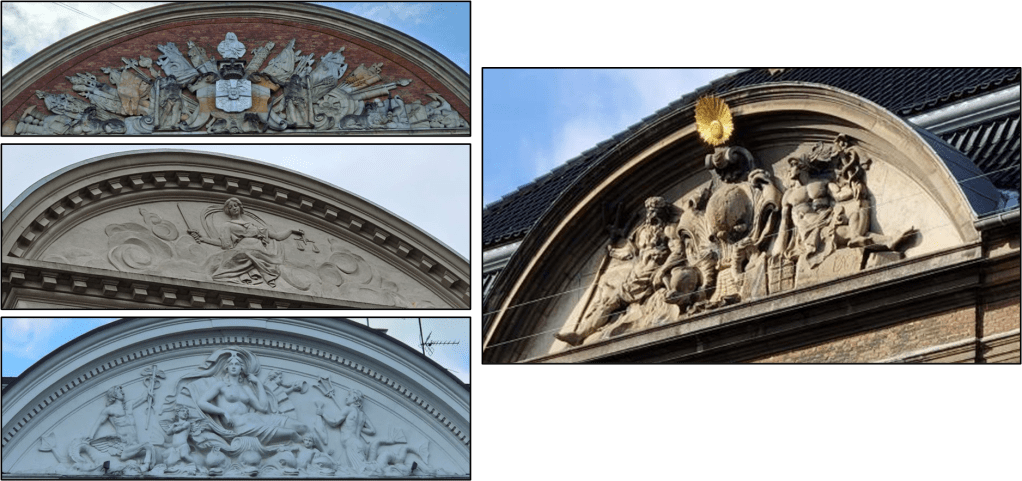
During our walk today, we saw several half-circle pediments on buildings.
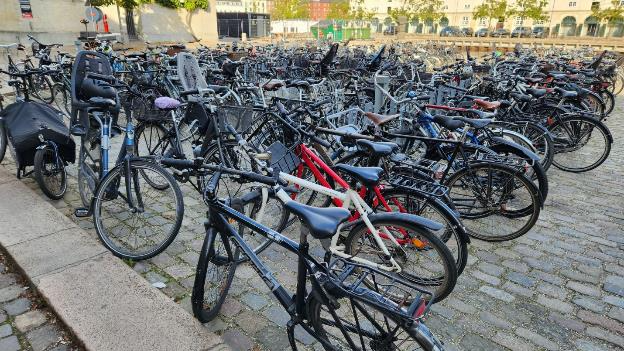
We’ve seen a lot of bicycle riding in Scandinavia over the past three months and Copenhagen is no exception. We passed this parking lot for bikes.
Here’s some data on that.
“49% of all trips to work or school in Copenhagen are by bike, up from 35% just ten years ago. This recent rise in cycling over the past decade is a result of continued municipal investment. The City has pledged investments equaling more than €40 per capita in bicycle infrastructure investments.”
This is impressive — it would be great if the United States would follow suit.
Next, we walked over the bridge to Slotsholmen, the small island that was the original settlement that started back in 1167.
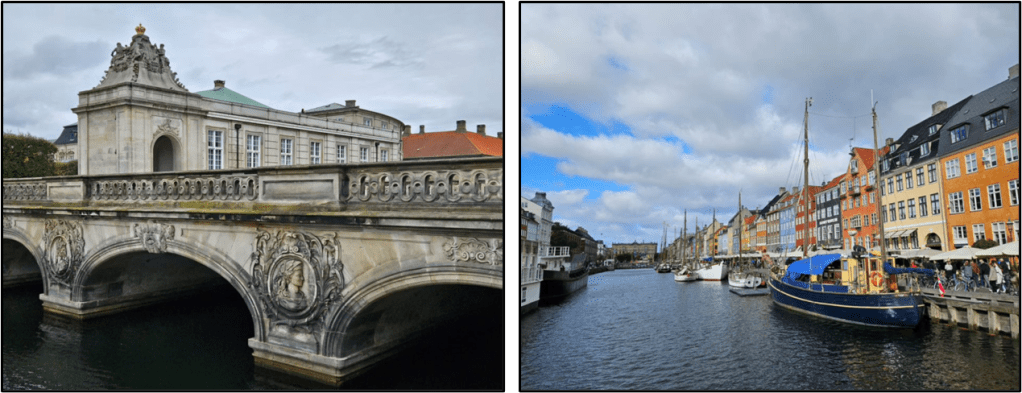
“Slotsholmen (English: The Castle Islet) is an island in the harbour of Copenhagen, Denmark, and part of Copenhagen Inner City. The name is taken from the successive castles and palaces located on the island since Bishop Absalon constructed the city’s first castle on the island in 1167 at the site where Christiansborg Palace lies today.
Recognised as the centre of the Government of Denmark since the Middle Ages, the island is sometimes referred to as ‘the Island of Power’ (Magtens Ø),and is lined with central government institutions and ministries; the name Slotsholmen is thus also frequently used as a metonym for overall Danish governmental administration.
The island is dominated by the vast Christiansborg Palace which houses the Danish Parliament, the Supreme Court of Denmark, the Prime Minister’s Office and the State Rooms of the Queen. Also located on the island are the most important ministries, the Danish National Archives, the Royal Danish Library, several museums and the historic buildings of the Christian IV’s Stock Exchange, the Chancellery and Christian IV’s Brewhouse.”
There are many important buildings on this island!
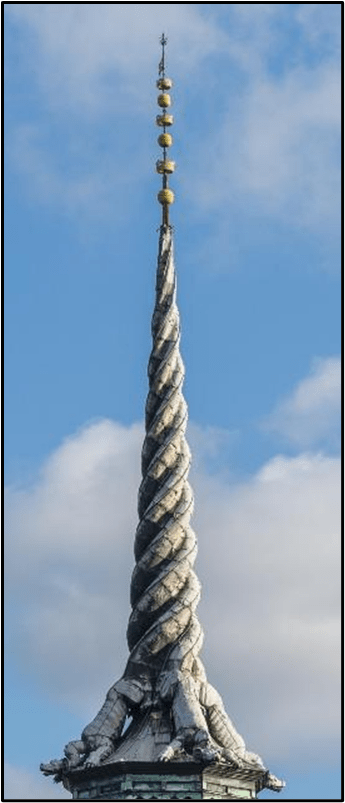
We are amazed at the many spires on top of buildings we are seeing here in Copenhagen — and they are not all located on top of a church. In the picture on the top left below, the bottom of the spire on the left is shaped like four dragons with their tails entwining. It’s located on the old stock exchange building (the other three pictures) that was built in 1646.
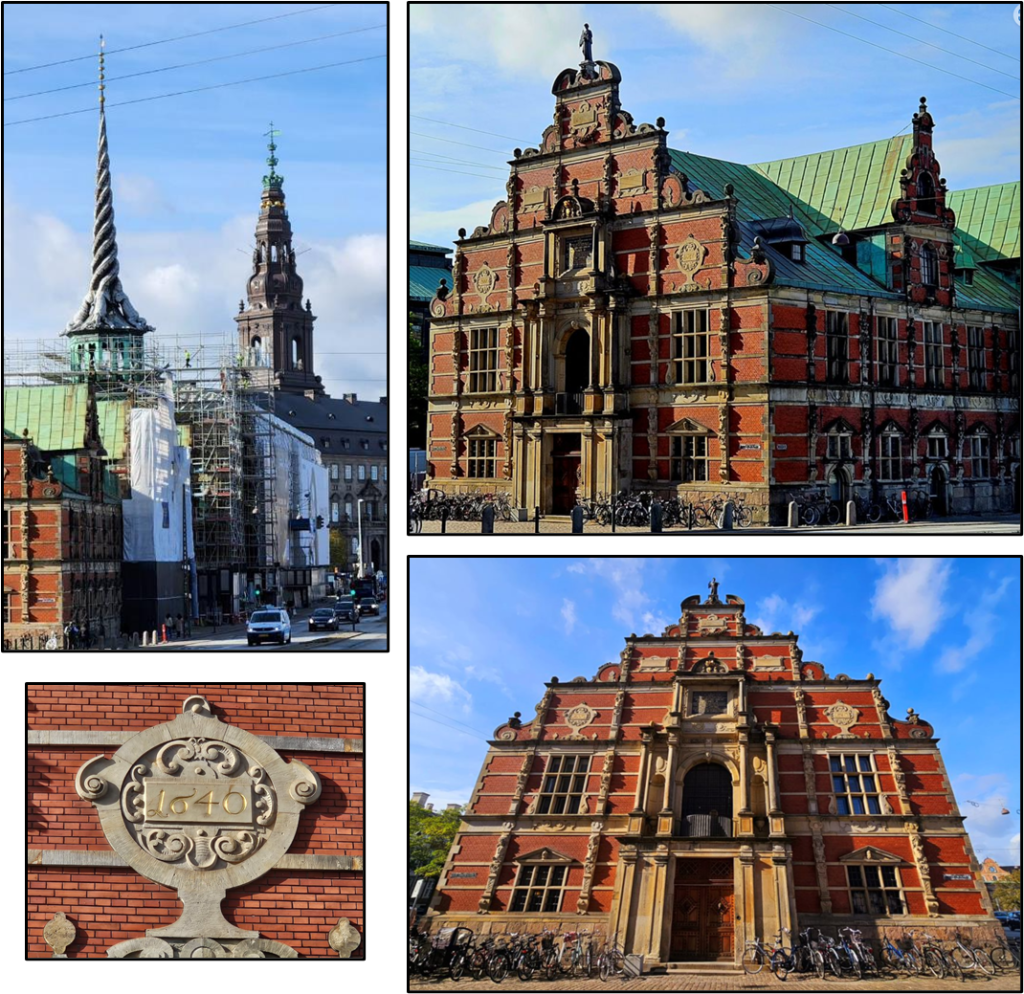
“Børsen (Danish for “the Exchange”), also known as Børsbygningen (“The (Stock) Exchange building” in English), is a 17th-century stock exchange in the center of Copenhagen. The historic building is situated next to Christiansborg Palace, the seat of the Danish Parliament, on the island of Slotsholmen. Børsen, a popular tourist attraction, is most noted for its distinctive spire, shaped as the tails of four dragons twined together, reaching a height of 56 metres.”
Here’s a better picture of it that I got off the internet.
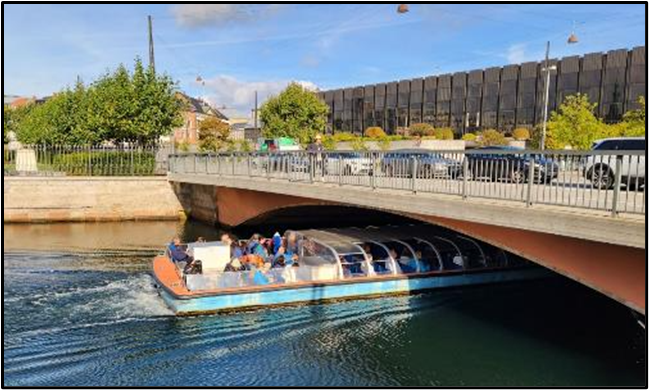
We saw a Tourist Canal Boat. The boats are built low and wide so they can fit under the low bridges.
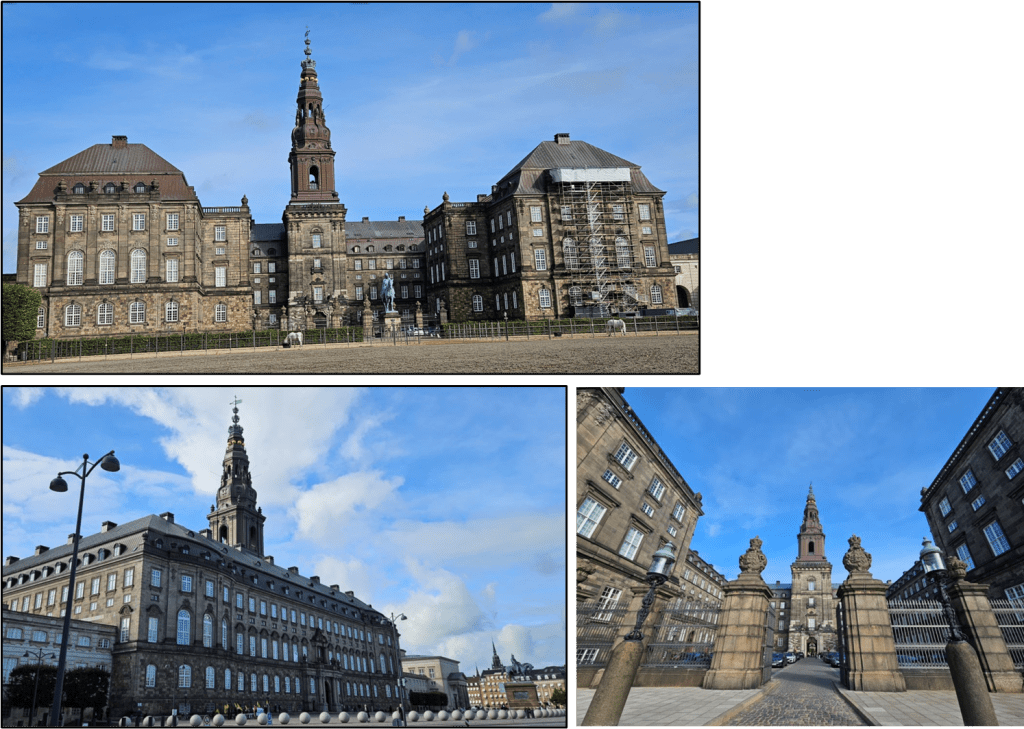
Below is a map of the island (Slotsholmen) that shows where many of the more popular tourist sites (buildings) are located that we walked by today.

The Christiansborg Palace was impressive. There are riding grounds in the foreground of this picture. We read that there are six white horses that pull the royal coach once per year on New Years Eve. The royal stables were just to the right. Two white horses were running around their paddocks.
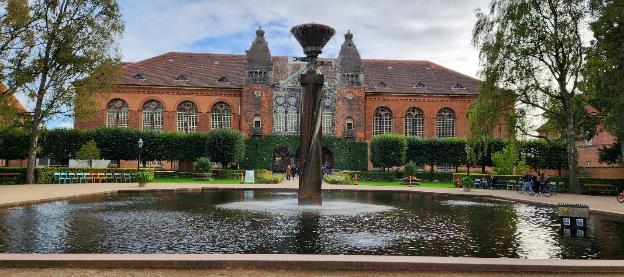
This is the old library with a garden in front.
I got my picture with Søren Kierkegaard.
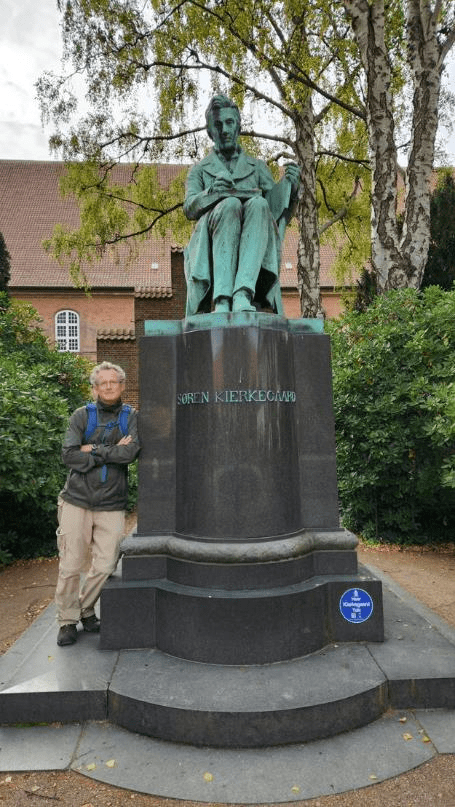
“Søren Aabye Kierkegaard (5 May 1813 – 11 November 1855) was a Danish theologian, philosopher, poet, social critic, and religious author who is widely considered to be the first existentialist philosopher. He wrote critical texts on organized religion, Christianity, morality, ethics, psychology, and the philosophy of religion, displaying a fondness for metaphor, irony, and parables. Much of his philosophical work deals with the issues of how one lives as a “single individual,” giving priority to concrete human reality over abstract thinking and highlighting the importance of personal choice and commitment. He was against literary critics who defined idealist intellectuals and philosophers of his time, and thought that Swedenborg, Hegel, Fichte, Schelling, Schlegel, and Hans Christian Andersen were all “understood” far too quickly by “scholars.””
Maybe I should read some Kierkegaard while we’re in Copenhagen.
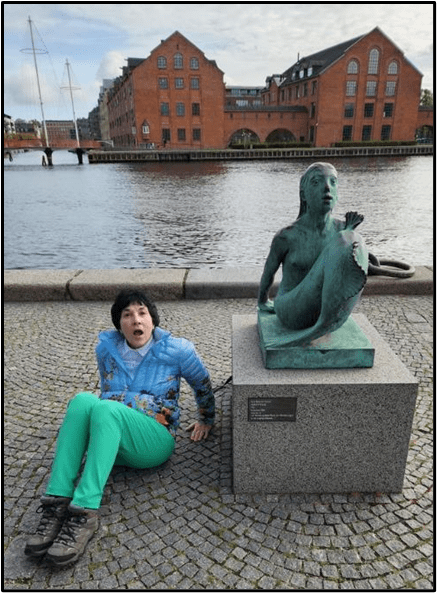
Patti found this mermaid sculpture. This is not the famous “Little Mermaid” which we hope to see soon, but a more modern rendition that is placed between the modern library and a canal. You can see Patti is gasping for breath, like a “mermaid out of water”.
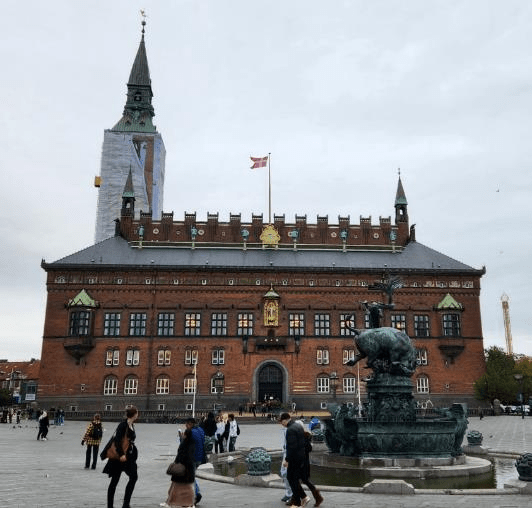
We walked to the Rådhusplassen where the Copenhagen City Hall is located.
“City Hall Square (Rådhusplassen) is a public square in the centre of Copenhagen, Denmark, located in front of the Copenhagen City Hall. Its large size, central location, and affiliation with the city hall makes it a popular venue for a variety of events, celebrations and demonstrations.“
We walked around the Latin Quarter which is a hodgepodge of touristy things like the Hard Rock Café and souvenir shops.
We walked by the Church of Our Lady, the Cathedral of Copenhagen, and went inside so Patti could pray.
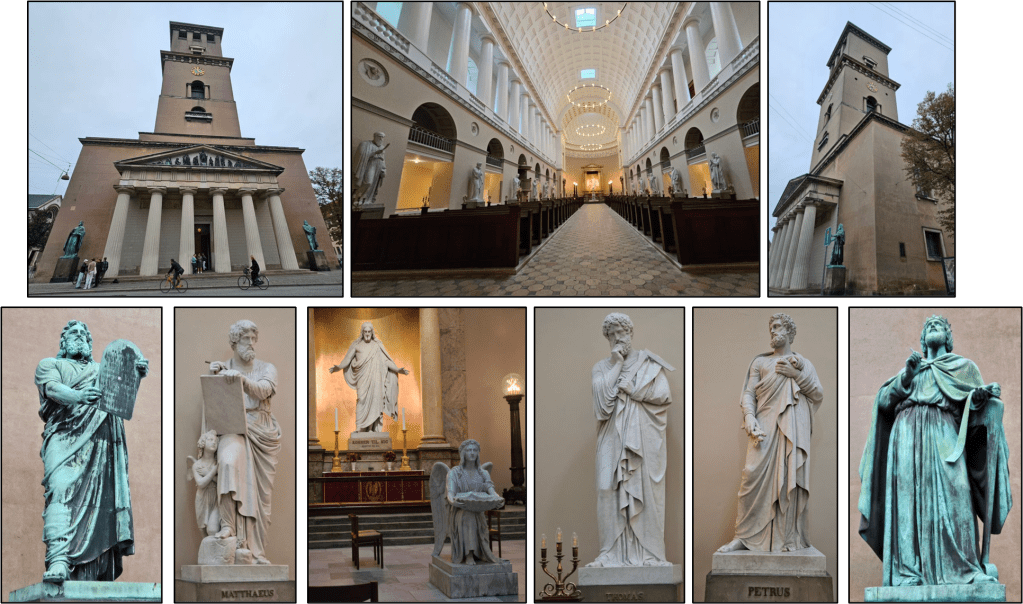
“The Church of Our Lady (Danish: Vor Frue Kirke) is the cathedral of Copenhagen. It is situated on the Frue Plads public square in central Copenhagen, next to the historic main building of the University of Copenhagen. The present-day version of the church was designed by the architect Christian Frederik Hansen (1756–1845) in the Neoclassical style and was completed in 1829.”
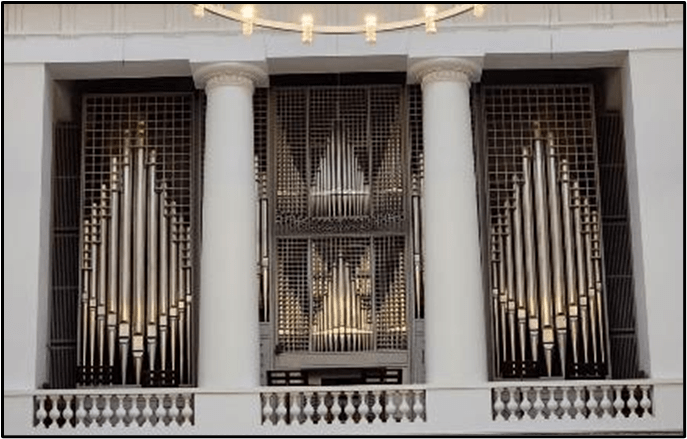
As usual, there was a magnificent organ in the loft.
After leaving the church, we stopped at a Vietnamese restaurant where I got some Pho and Patti got edamame.
October 11, 2023 – Wednesday: A Planning Day
We took today off. First, we went for jogs. But, as always, Patti objects to my use of the word “jog”, she says that she goes “on a run” and won’t use the word “jog”. Are semantics really that important at our age? How fast is a “jog” and how fast is a “run”? Or is this just an emotional thing? Patti says the word “jog” is from the 70s or 80s. I would value your opinion on that.
We’ve been hearing about Smørrebrød, which is an open-faced cold sandwich popular in Copenhagen. We saw some restaurants yesterday selling them and there is one near us, so I convinced Patti to go there with me for lunch today. I am more culinarily adventurous than Patti.
On the way we passed a café with many young mothers inside, as evidenced by the 10 strollers parked outside. Google Translate gave me “The Child Bubble” as the English translation of the name of this restaurant. I guess the place serves a need.

The restaurant we went to is called the Sørenson Dinér Transportable which opened in 1896.
“Th. Sørensen Dinér Transportable was established in 1896. Today, it is the fourth generation that runs the family business. We continue to take pride in the traditions of complete open sandwiches and well-prepared Danish food.”
There are stainless steel trays in the window displaying some of the Smørrebrød that is available.

Here’s a picture of Patti with our order.
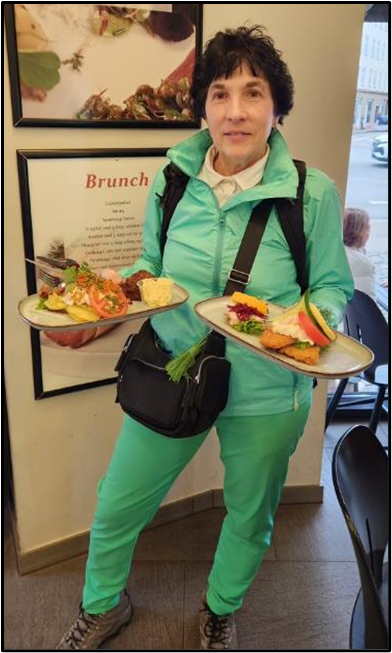
I got one Fish and one Pork Belly. Patti got a Danish meatball and a Chicken Salad with Potato.
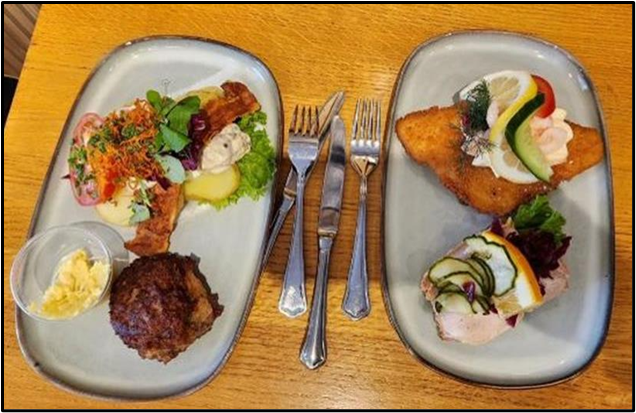
I enjoyed mine and Patti ate most of hers and said she didn’t need to eat Smørrrebrød again.
“Smørrebrød is a traditional Danish open-faced sandwich, typically made with rye bread and topped with various ingredients such as meat, fish, cheese, vegetables, and spreads. It is often served as a lunch dish or snack in Denmark.”
I will likely be eating more Smørrrebrød as we walk around Copenhagen over the next week.
October 12, 2023 – Thursday: The Little Mermaid
Google emailed me my September Timeline” update. It looks accurate. The Oslo pin is just from our 1 ½ hour layover in the train station. I like seeing where we’ve been.
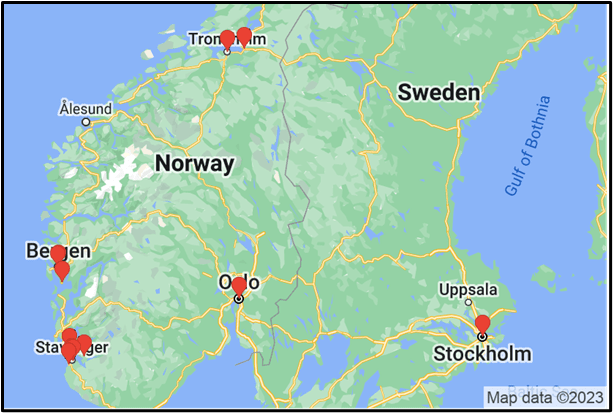
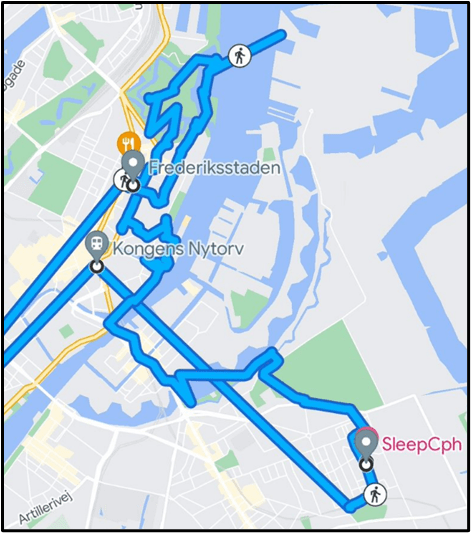
The weather was looking good today so we headed out on another city walk. Our plan was to see The Little Mermaid Statue that is famous here and is from the book The Little Mermaid, written in 1837 by Hans Christian Andersen, the Danish Author. Google Maps Timeline recorded our walk — it’s mostly accurate. We walked about nine miles today.
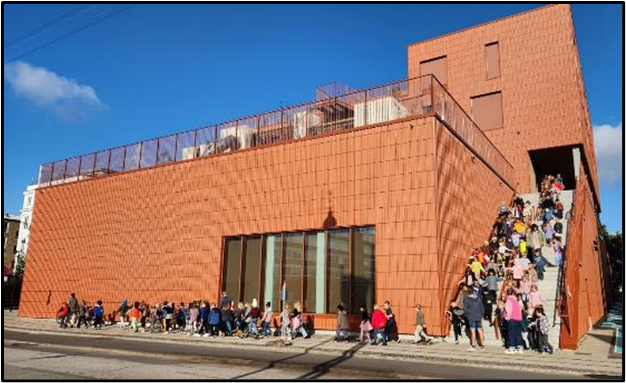
On the way out of our neighborhood we passed a school where the children were all coming out the upper floor and down the steps. It’s a nice-looking school building.
Further along our route, we walked through an interesting area of older houses built along a canal. I like the pink house shaped like a teardrop camper. We discovered later that this area is referred to as Freetown Christiania.
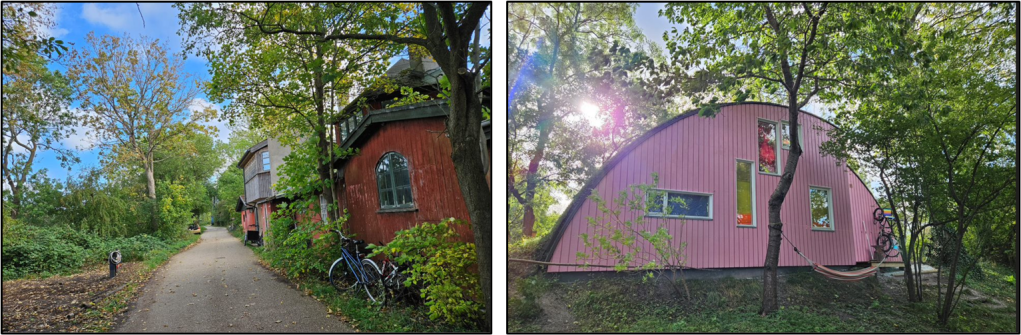
“Freetown Christiania, also known as Christiania or simply the Staden, is an intentional community and commune in the Christianshavn neighborhood of the Danish capital city of Copenhagen. It is an 84-acre anarchic enclave founded in 1971 when a brigade of young squatters and artists took over an abandoned military base on the edge of town and proclaimed it a “free zone” beyond the reach of Danish law. They christened it Christiania.”
We also walked by a sports park and in the distance saw the stacks of what looks like a power generation plant, including a silver building to the left with one stack halfway down the side that I couldn’t quite figure out. After doing some research, I discovered that it is actually a ski resort called Copenhill. We also discovered that the sports park, Klovermarken (Clover Field in English), also has an interesting history.
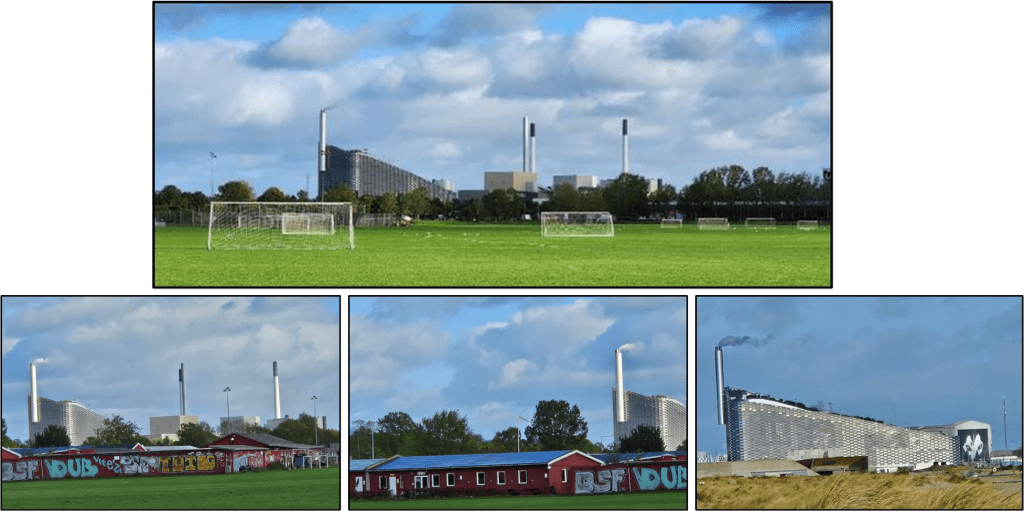
“Kløvermarken (the Clover Field) is a large green space in the Amager East district of Copenhagen, Denmark. Originally a military area, it has later been home to both Copenhagen’s first airfield and a camp for German refugees after World War II. It now features football pitches and other sports facilities as well as a nature centre for children.
During the last months of World War II, large numbers of German refugees arrived in Denmark. They had been evacuated throughout the Operation Hannibal across the Baltic Sea after the Red Army started the East Prussian and East Pomeranian Offensives. Of the 240,000 German refugees who came to Denmark, 92,000 were placed in the Copenhagen area, distributed on 152 sites. After the liberation in May 1945, they were collected in large, guarded camps. A town of hutments was built at Kløvermarken where up to 19,000 refugees, mainly women and children were placed. Most of them had been sent back to Germany by August 1947 but a minor section of the camp lingered until it was finally shut on 14 February 1949.”
Here are some pictures of Copenhill retrieved from the internet.
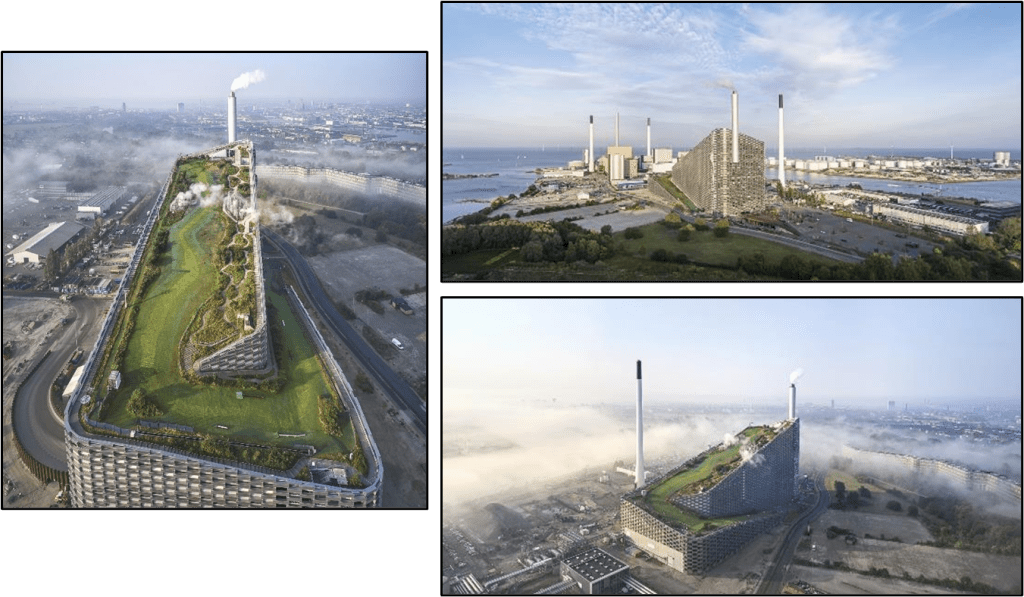
“Copenhill is an artificial ski slope on the roof of an ultra-modern energy plant, used also for hiking and climbing. Spectacular and innovative in the true sense of the words. That’s CopenHill. The artificial skiing slope and the recreational hiking area opened in fall 2019, built on top of the new waste management center. This sounds like something out of a sci-fi fantasy but is a reality since the power plant opened in 2017 under the name ARC (Amager Resource Center).”
“A year since its opening, the snow-free ski hill and entertainment hub that sits above a waste-to-energy power plant in Copenhagen is fully open to outdoor enthusiasts. The multi-use site, which is located at the Amager Resource Centre, even has the world’s tallest climbing wall, an 80-meter-high rock structure that scales the entirety of the building. Copenhill is the project of Danish architectural firm BIG and is the highest outlook in the capital city. The new complex also boasts multi-faceted energy reuse, with the indoor plant converting waste into heat for residents’ homes, while the biodiverse hill outside absorbs heat, filters the air, and minimizes water runoff.”
This evening we talked about walking over there to see it. Maybe we will pay whatever admission charge there is to hike the path.
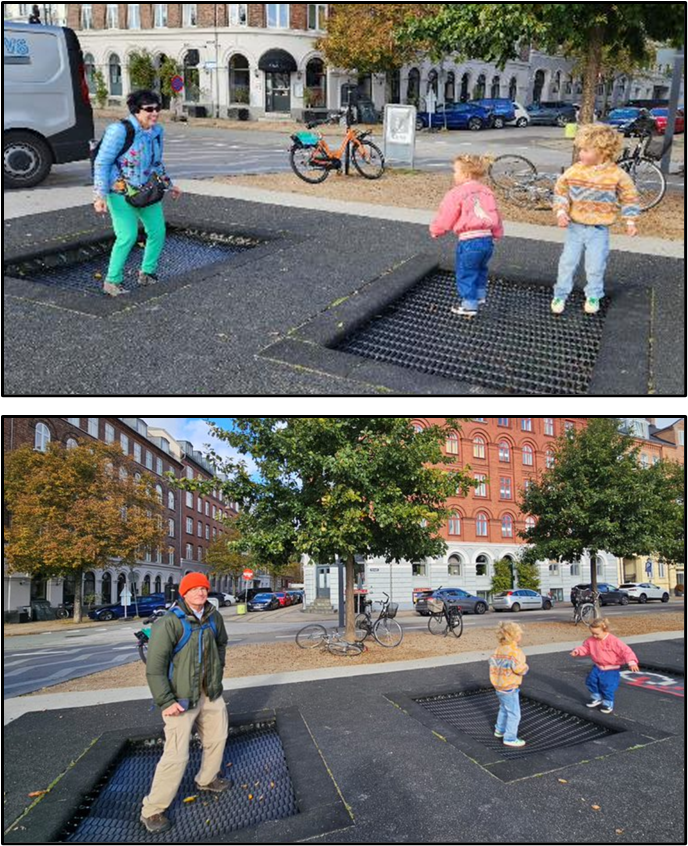
We continued our walk through Christiana toward the City Centre. At a playground along the harbor, we jumped on the trampolines. It looked like these two girls weren’t quite sure what to make of us.
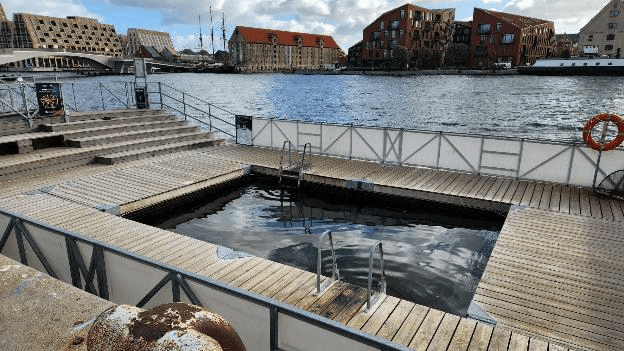
This swimming pool was open to the public, but we didn’t have our bathing suits with us. The sides are open to the harbor, so it’s filled with Copenhagen harbor seawater. I assume it rises and falls with the tides.
We walked along canals, with all the rest of the tourist multitudes.
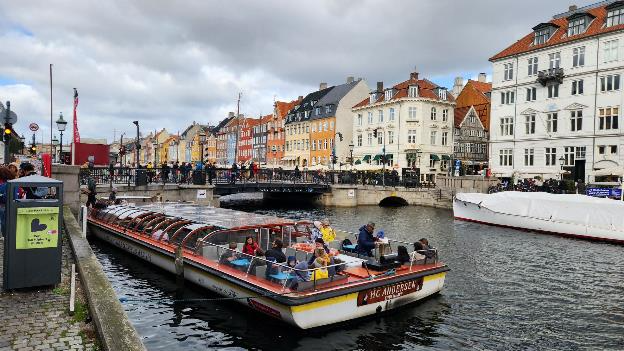
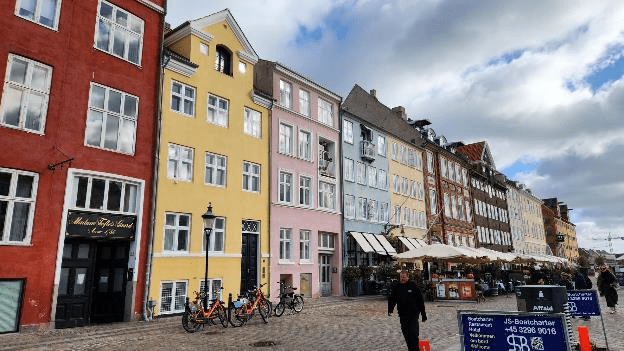
The old canal-side buildings that used to be warehouses are, as we’ve seen in other Scandinavian port cities, now converted into shops, restaurants, and apartments.
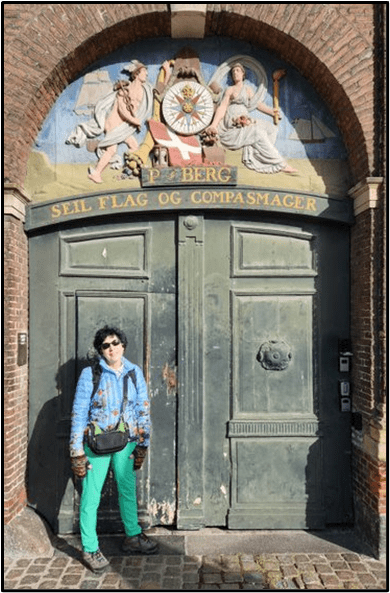
We liked this old door. The keystone is dated 1737. The English translation says they make flags, sails and compasses.
We went into Frederick’s Church which has an amazing dome.
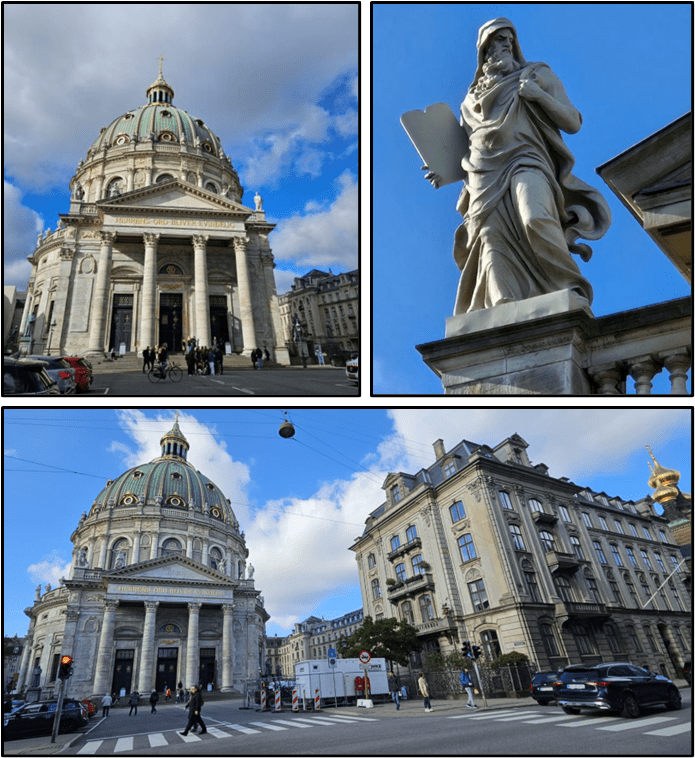

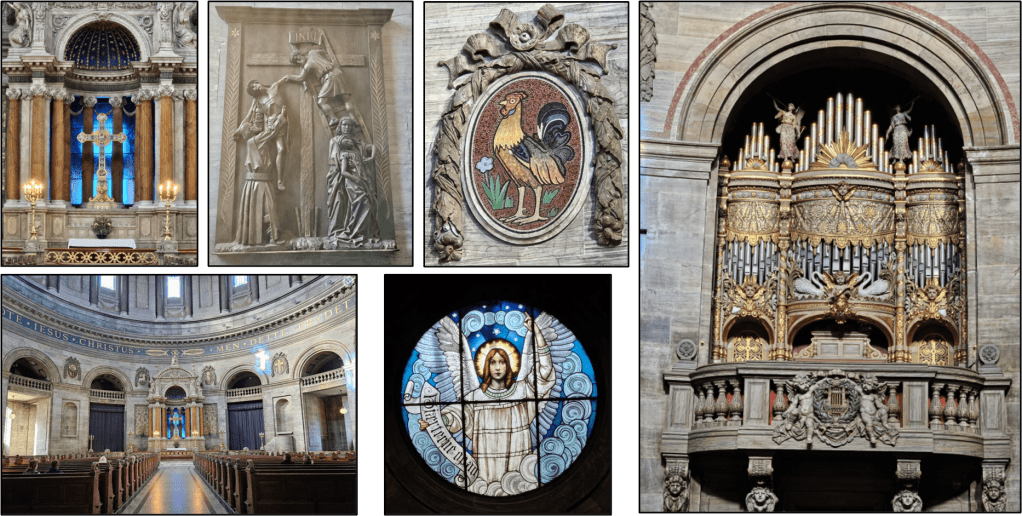
“Frederik’s Church (Danish: Frederiks Kirke), popularly known as The Marble Church (Marmorkirken) for its rococo architecture, is an Evangelical Lutheran church in Copenhagen, Denmark. The church forms the focal point of the Frederiksstaden district; it is located due west of Amalienborg Palace.”
At lunchtime we stopped at a Thai restaurant. I’ve liked Thai food for a long time and Patti likes Pad Thai, so it’s always an option for us.
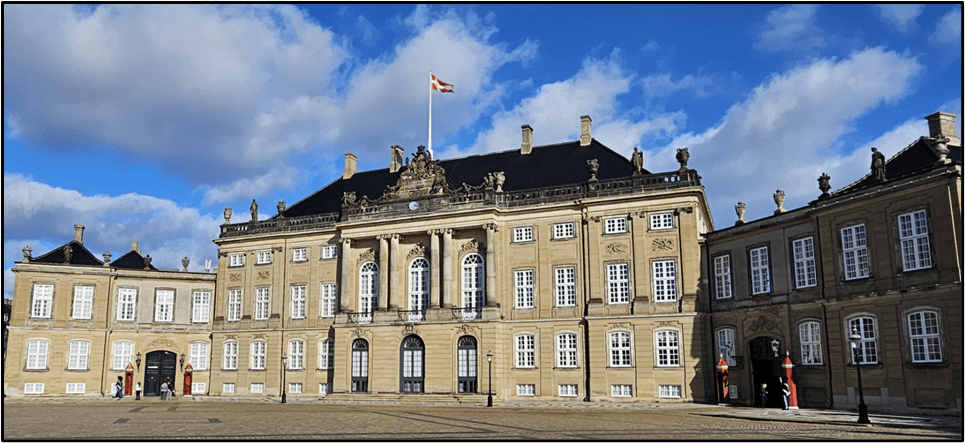
After lunch we walked over to Amelienborg. This collection of four palaces seems unusual because there really are four separate palaces that have been lived in by different members of the royalty here down through the centuries.
“Amalienborg is the official residence for the Danish royal family, and is located in Copenhagen, Denmark. The Danish Head of State, Queen Margrethe ll, resides in the palace during autumn and winter. It consists of four identical classical palace façades with rococo interiors around an octagonal courtyard (Danish: Amalienborg Slotsplads); in the center of the square is a monumental equestrian statue of Amalienborg’s founder, King Frederick V. Amalienborg was originally built for four noble families; however, when Christiansborg Palace burned on 26 February 1794, the royal family bought the palaces and moved in. Over the years various monarchs and their families have resided in the four different palaces.”
There were guards marching around, armed with AR-15 style rifles.
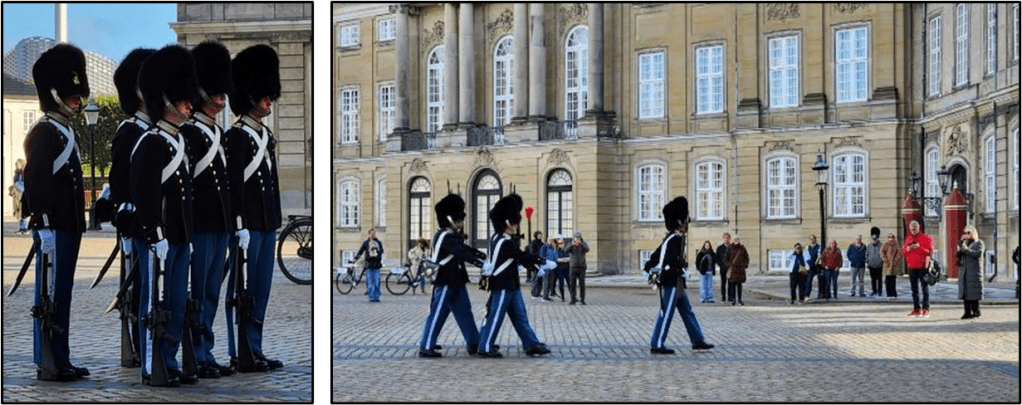
We were careful not to do anything that might be against the rules.
Here’s a view of one of the four palaces, the other three look almost identical to this one.
After Amelienborg we walked to Kastellet.
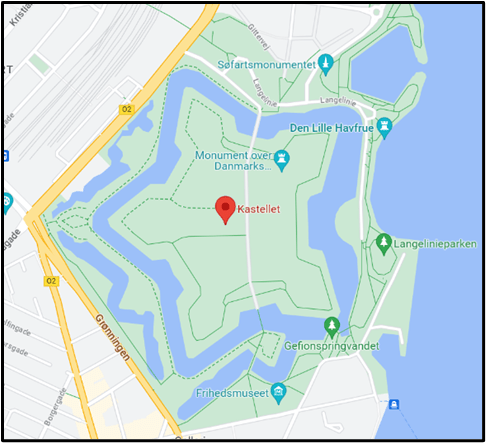
“Kastellet is a citadel located in Copenhagen, Denmark. It is one of the best preserved fortresses in Northern Europe. It is constructed in the form of a pentagon with bastions at its corners. Kastellet was continuous with the ring of bastioned ramparts which used to encircle Copenhagen but of which only the ramparts of Christianshavn remain today. A number of buildings are located within the grounds of Kastellet, including the Citadel Church as well as a windmill. The area houses various military activities but it mainly serves as a public park and a historic site.”
On Google Maps it looks like this. You can clearly see the five bastions.
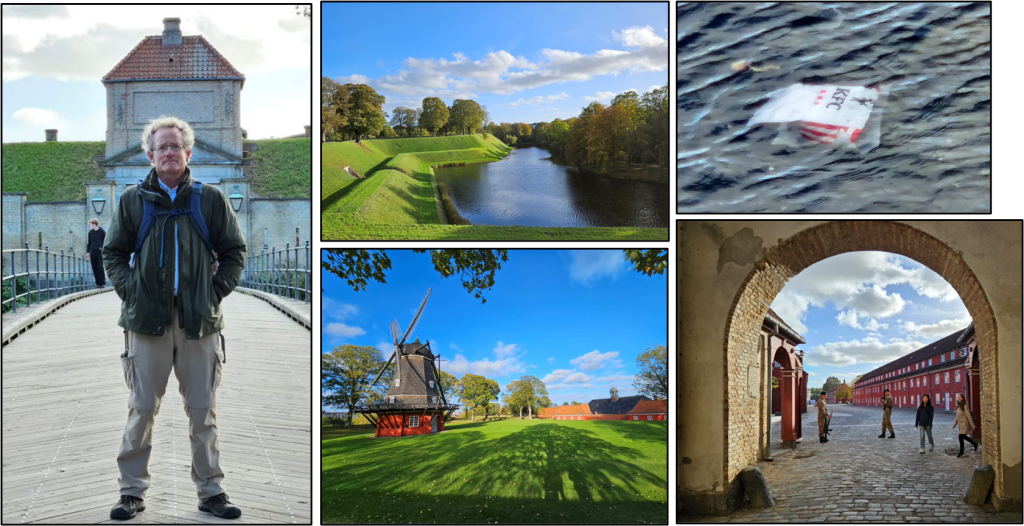
Below are some pictures we took at the fortress. Me in standing on the bridge over the mote in front of the fortress gates. The mote with the steep ramparts to keep the enemy away. A KFC (Kentucky Fried Chicken box floating in the mote) — we’ve seen KFC restaurants in nearly every country we’ve traveled through. The windmill. The entrance to the fortress.
We walked by the Gefion Fountain.
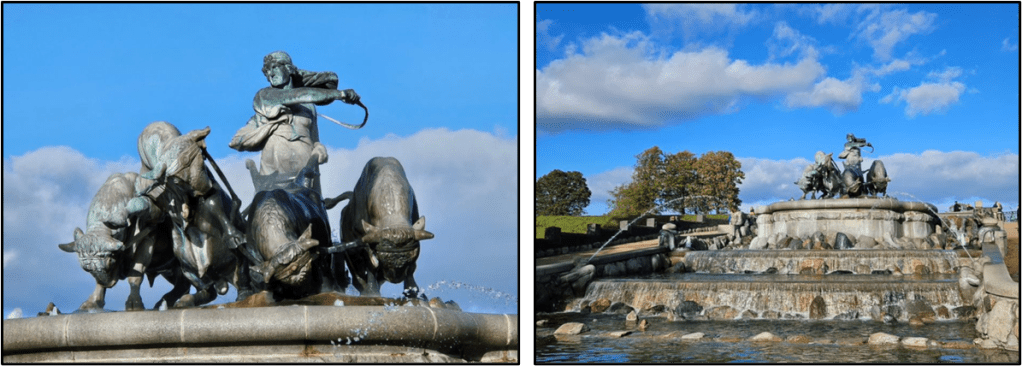
“The Gefion Fountain is a large fountain on the harbor front in Copenhagen, Denmark. It features a large-scale group of oxen pulling a plow and being driven by the Norse goddess Gefjon. It is located in Nordre Toldbod area next to Kastellet and immediately south of Langelinie.”
I’d never heard of this Goddess, Gefion, so I’ve educated myself with a Google search.
“In Norse mythology, Gefjon is a goddess associated with ploughing, the Danish island of Zealand, the legendary Swedish king Gylfi, the legendary Danish king Skjöldr, foreknowledge, her oxen children, and virginity.”
From there we didn’t have far to walk to get to our destination for the day. And here we are with…
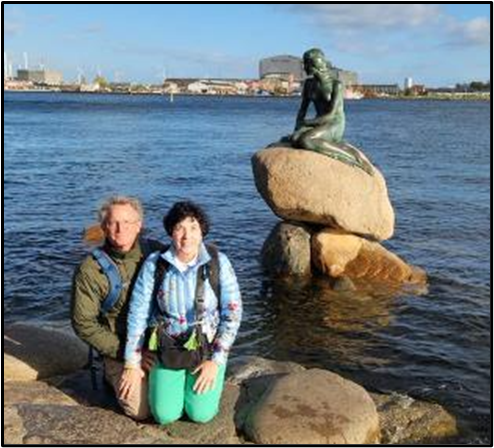
…The Little Mermaid!
“The Little Mermaid (Danish: Den lille Havfrue) is a bronze statue by Edvard Eriksen, depicting a mermaid becoming human. The sculpture is displayed on a rock by the waterside at the Langelinie promenade in Copenhagen, Denmark. It is 1.25 meters tall and weighs 175 kilograms. Based on the 1837 fairy tale of the same name by Danish author Hans Christian Andersen, the small and unimposing statue is a Copenhagen icon and has been a major tourist attraction since its unveiling in 1913.”
There was a big crowd of tourists getting pictures with the mermaid, so we waited our turn and got someone to take our picture.
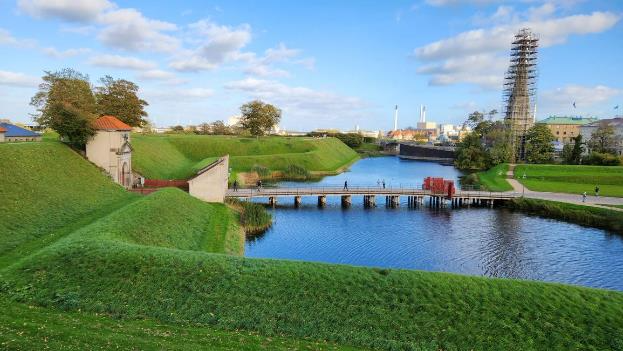
After that we walked through the Kastellet to see the bastions and ramparts of the old citadel. It’s been well maintained and is a peaceful place to walk. In this picture you can see one of the bridges going over the mote.
By this time it was late afternoon and we decided to head back to our Airbnb. I got on Google Maps which showed me a way home riding the Metro. We haven’t ridden the subway here yet so that sounded like a good idea. We were supposed to take the M4 to the M2, as in this map.
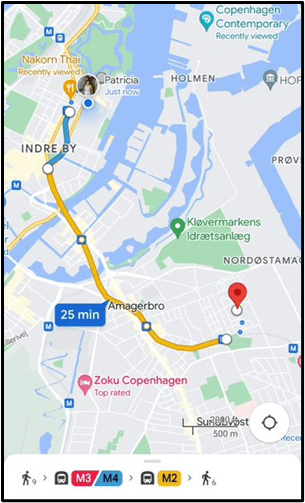
But we got on the M4 going the wrong direction so we got off after one stop and went back the correct way, and then correctly transferred to the M2 going the correct way. It wasn’t a big problem. The Copenhagen metro was modern, clean and quiet. We arrived safely back at our Airbnb — and another day was done.
 2024 TRAVEL TALES