This update is part three of our two-week stay in Bergen, Norway. It covers September 18 – 20. “Any text in quotes and Italics has been copied and pasted from some informational website like Wikipedia.”
This is our 50th travel update for 2023. You can tell this by the numbering system –> 2023-50.
September 18, 2023 – Monday: The Bergen Aquarium
It rains a lot in Bergen, Norway, in fact:
“Topping the data table for being both the city with the highest average rain days per month (12.7) as well as the highest average daily rainfall (8.8mm), Bergen is the outright rainiest city in Europe. On average, Bergen enjoys around 239 rainy days a year due to its particular microclimate – it is surrounded by seven mountains and located on the coast.”
The weather forecast for this week is 100% rain every day. Despite the rainy forecast, we still plan to venture out. Today we went to the Bergen Aquarium.
“Bergen Aquarium is a public aquarium in Bergen, Norway. It is situated on the Nordnes peninsula and is one of Bergen’s tourist attractions. When it opened on 27 August 1960, it was considered to be the largest and most modern aquarium in Northern Europe. Bergen Aquarium features more than 300 species. The complex houses over 60 tanks of fish, marine invertebrates, as well as three outdoor ponds with seals, penguins and cyprinids and a tropical branch with reptiles.”
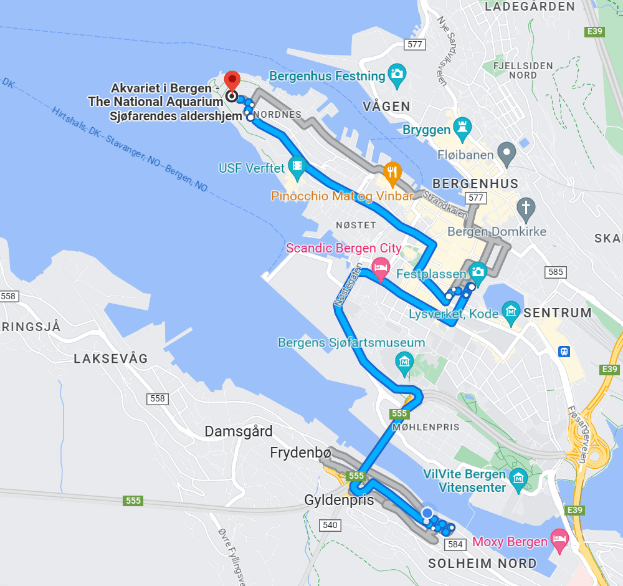
Since rain was forecast, we decided to take the bus to the aquarium. First the #13 and then #11. Google Maps plotted the path. It was a quick and easy trip.
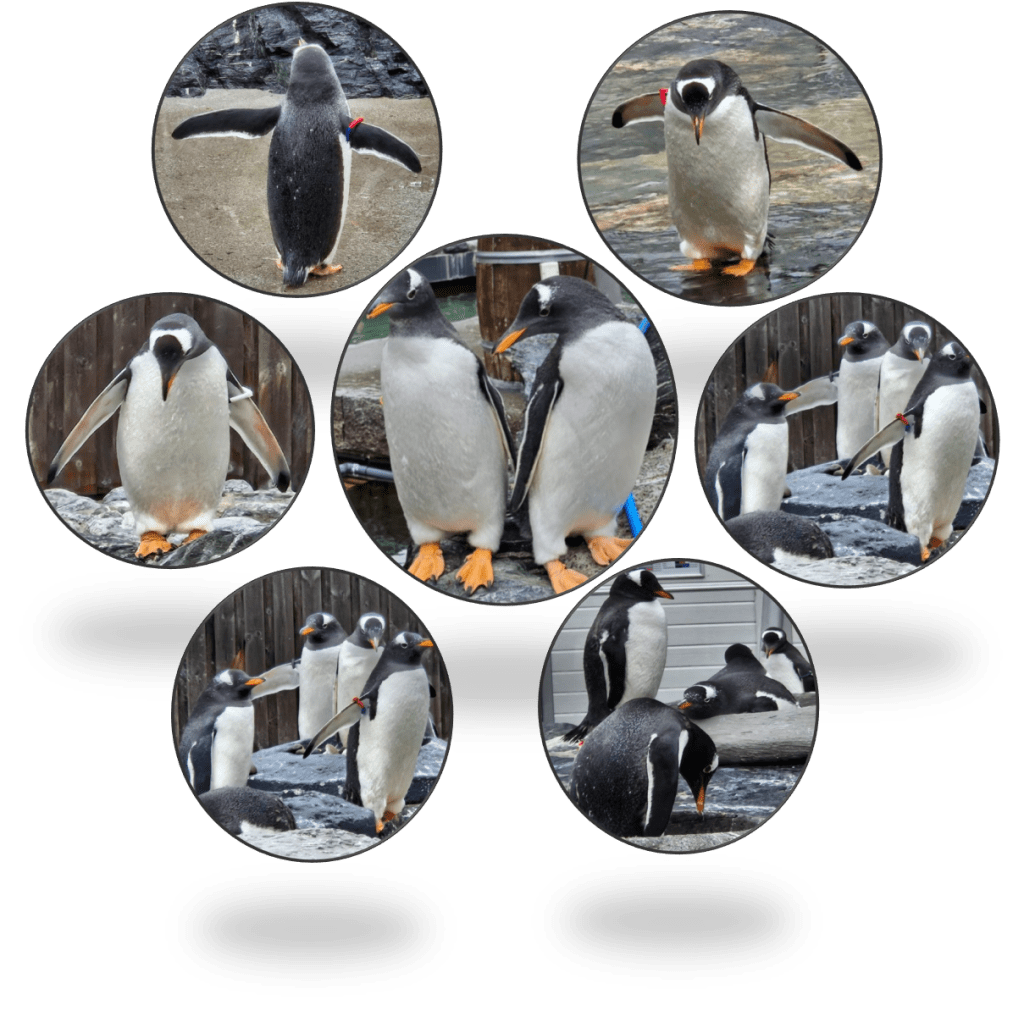
The first animal encounter, after purchasing the tickets and walking through the gift shop, is the Penguin habitat. There were lots of Gentoo Penguins standing, walking and laying around. Their habitat is outdoors, and the Bergen weather appears to suit them just fine them all year long.
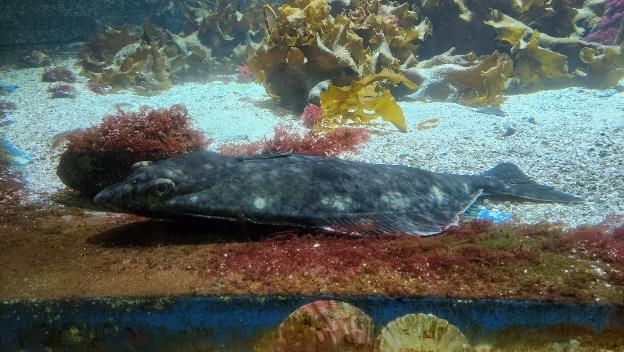
The first room inside the aquarium is called the Rotunda and it has eight large aquariums. This one had a lot of local species of flatfish like the Halibut.
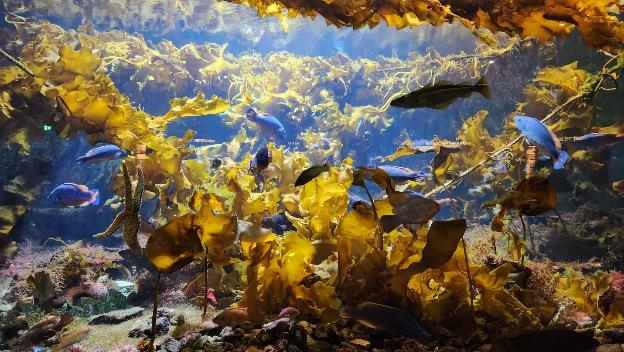
There was a kelp habitat with some wrasse.
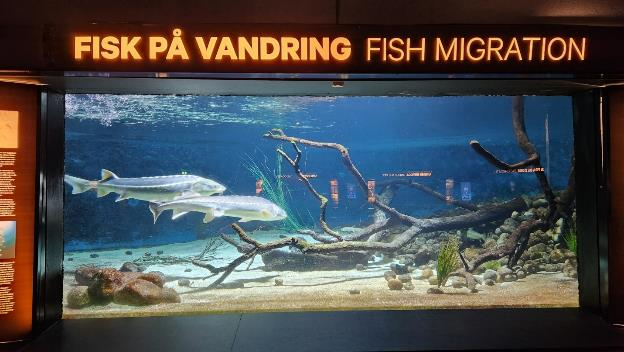
Another tank had several large Russian Sturgeon.
This aquarium had a very interesting story about a species of salmon, the Bleke, that had been landlocked in a fjord about 9,000 years ago and was able to adapt to live its whole life in fresh water, instead of migrating to the sea then coming back into fresh water to spawn.
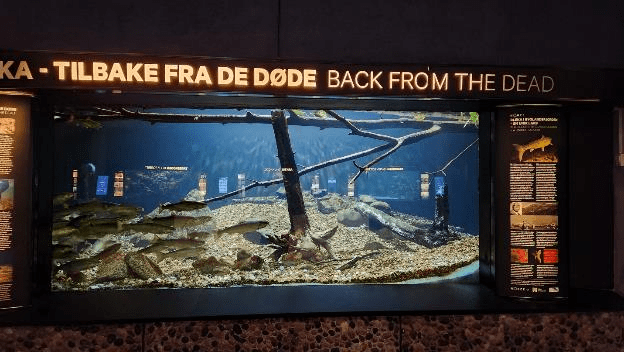
It’s a pretty fish.
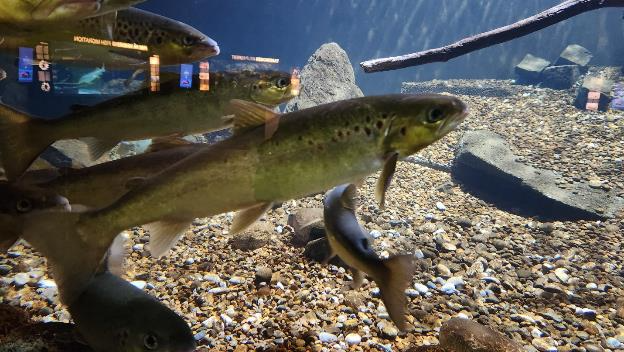
We learned an interesting fact about migratory fish today and two new words: Anadromous and Catadromous.
“Most migratory fish are either anadromous or catadromous. Anadromous fish spend most of their adult lives at sea but must return to freshwater to spawn. Catadromous fish live most of their adult lives in freshwater but must return to saltwater to spawn.”
Most Salmon are anadromous, but the European Eel is catadromous. I want to remember these words as they may come up on an episode of Jeopardy some day!
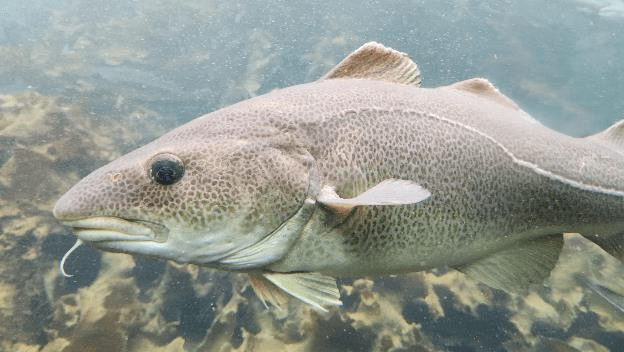
This aquarium had local eatable fish like Cod and Saithe.
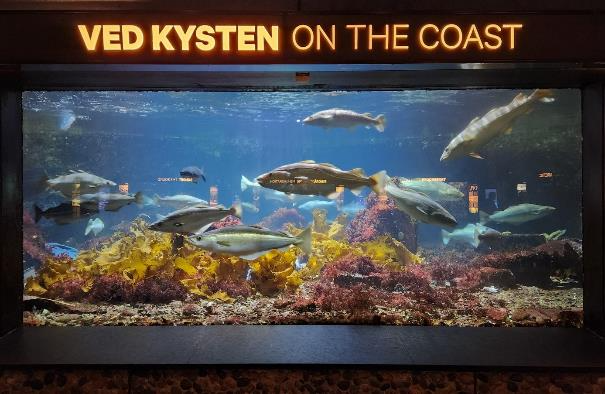
I think the Cod is a very pretty fish.
The Saithe (AKA Pollock) is neat-looking too.
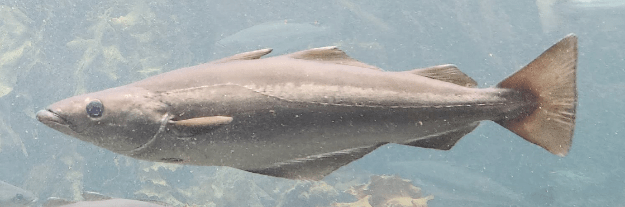
“The saithe (Pollachius virens) is a species of marine fish in the Pollock genus Pollachius. Together with P. pollachius, it is generally referred to in the United States as pollock.”
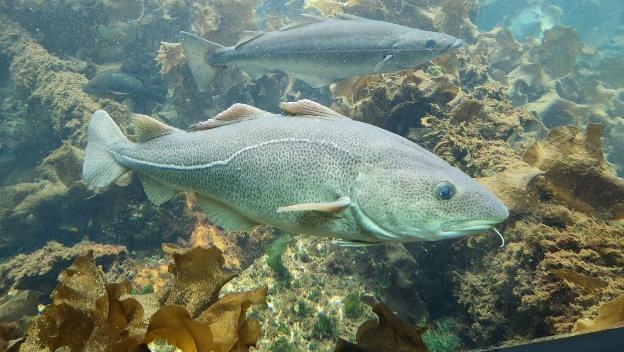
Here’s a Cod and a Saithe together.
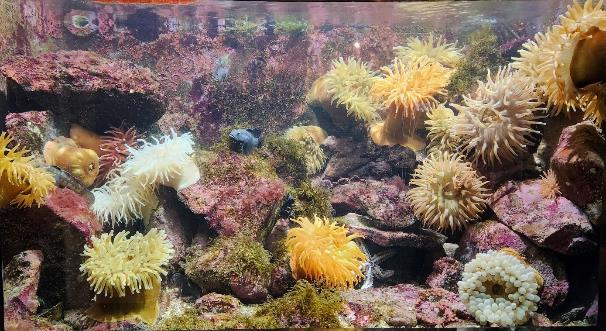
I like sea anemone tanks like this one.
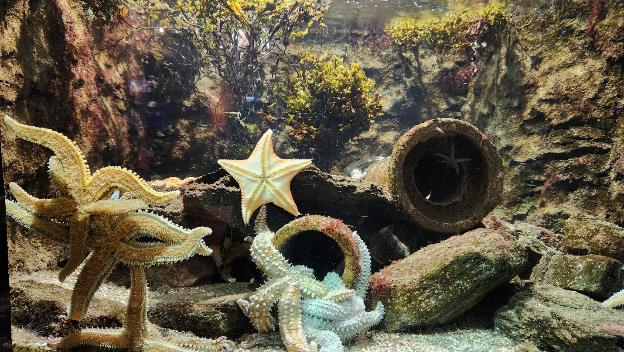
Some of the Sea Stars in this tank were all tangled up together.
All the aquariums we’ve been to in Norway have Lumpsuckers. They can adhere to flat surfaces using their modified pelvic fins. It’s a funny-looking fish.
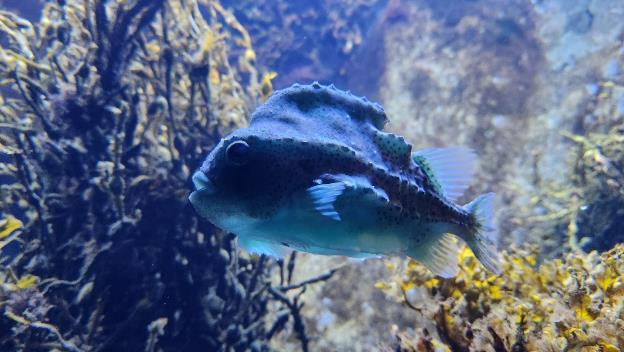
“The Cyclopteridae are a family of marine fishes, commonly known as lumpsuckers or lumpfish, in the order Scorpaeniformes. They are found in the cold waters of the Arctic, North Atlantic, and North Pacific oceans. The greatest number of species are found in the North Pacific. The family name Cyclopteridae derives from the Greek words κύκλος (kyklos), meaning “circle”, and πτέρυξ (pteryx), meaning “wing” or “fin”, in reference to the circle-shaped pectoral fins of most of the fish in this family.” Lumpsuckers are named appropriately enough; their portly bodies are nearly spherical with generally drab coloration and lithic patterns. The “sucker” part refers to the fish’s modified pelvic fins, which have evolved into adhesive discs (located ventrally, behind the pectoral fins); the fish use these discs to adhere to the substrate. Many species have bony, wart-like tubercles adorning the head and body; these are important taxonomic features of the family.”
We went to the aquarium restaurant for lunch. I ordered a Fishburger (appropriately) and Patti ordered Carrot Soup with bread. It was a pretty table, and my fishburger was good.

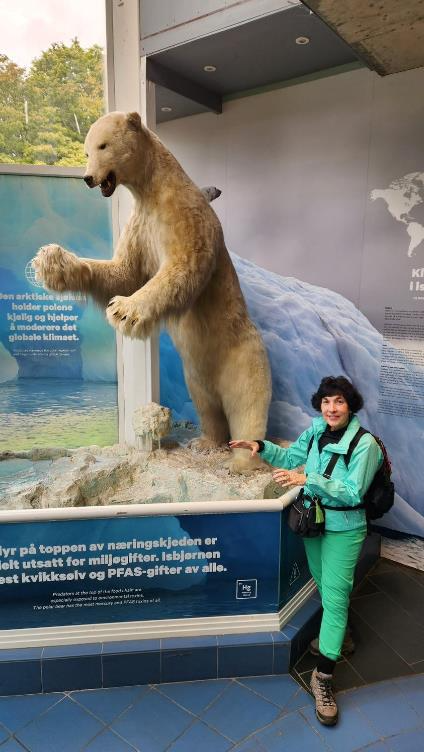
After lunch, I took Patti’s picture with the stuffed Polar Bear. I don’t think she looks quite as fierce as the bear.
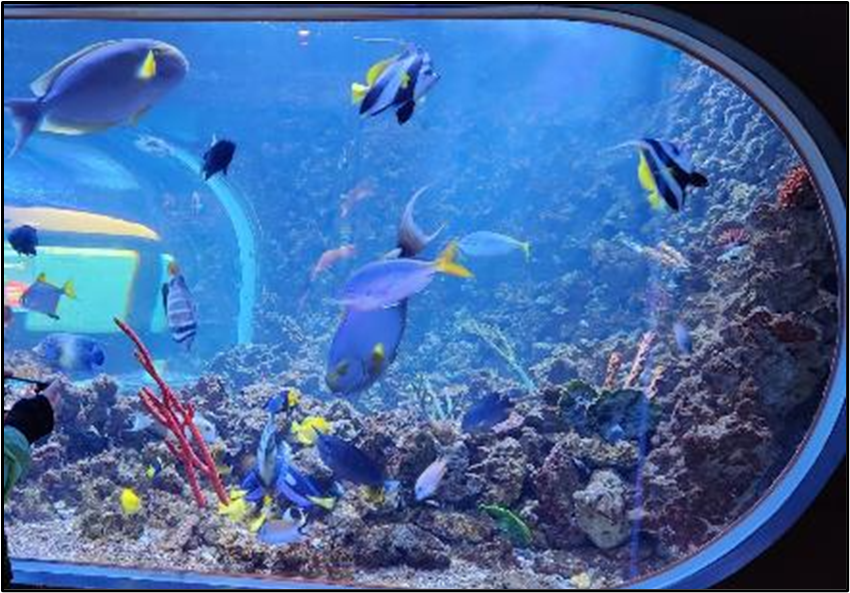
There was a Tropical area with warm-water coral tanks.
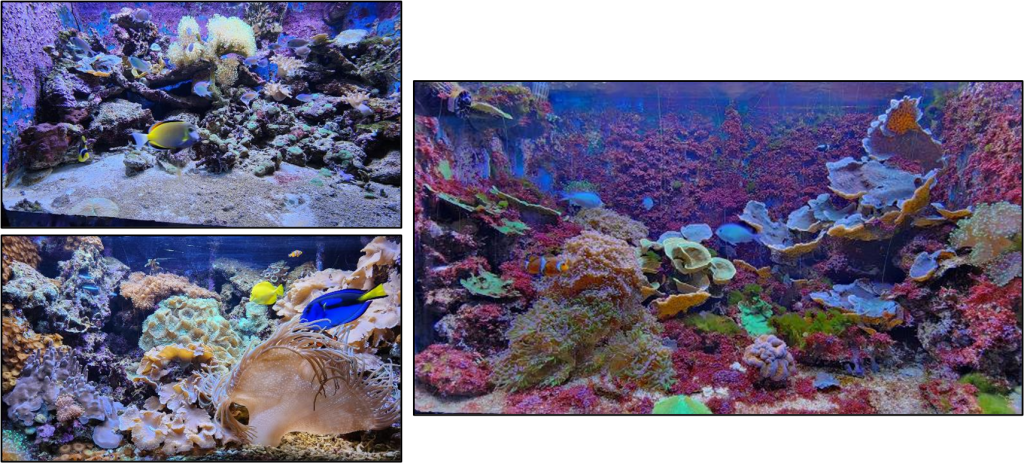
This was the largest tropical tank and there was a tunnel through it.
Patti’s favorite fish here was the Picasso Triggerfish. She said it resembled a piece of artwork even before we learned the type of fish it is!!!
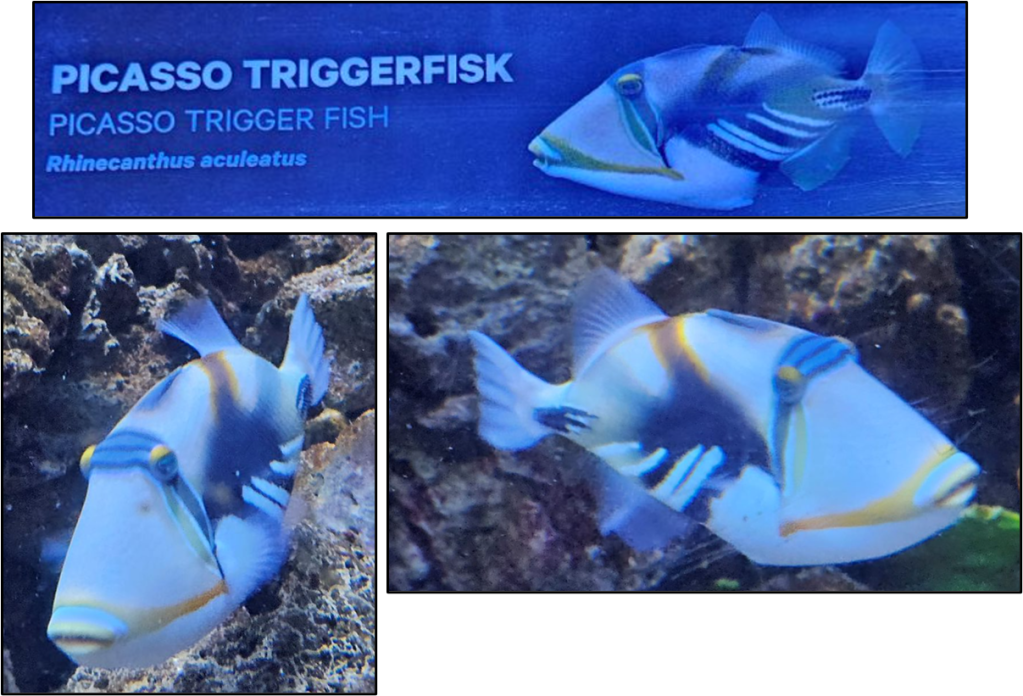
“The lagoon triggerfish (Rhinecanthus aculeatus), also known as the blackbar triggerfish, the Picasso triggerfish, or the Picassofish, is a triggerfish, up to 30 cm in length, found on reefs in the Indo-Pacific region.”
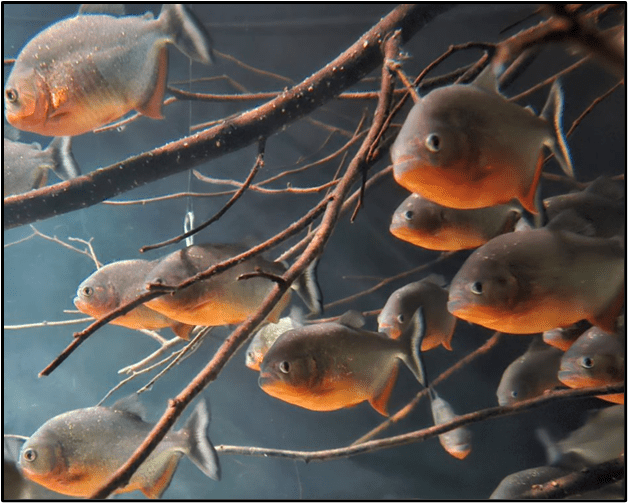
There was also a tank full of Piranhas. “Piranhas range from northern Argentina to Colombia, but they are most diverse in the Amazon River, where 20 different species are found. The most infamous is the red-bellied piranha (Pygocentrus nattereri), with the strongest jaws and sharpest teeth of all.
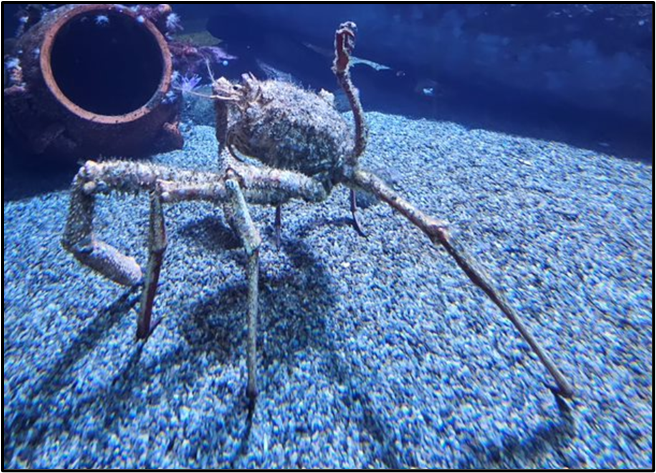
This deepwater crab was interesting. Its back two legs are adapted to carry seaweed over its back, as a form of camouflage. In this aquarium the back two legs were just sticking up not doing anything.
The aquarium sponsors a research and training vessel called the Statsraad Lehmkuhl which is also an event venue in Bergen. They had a model of the ship.
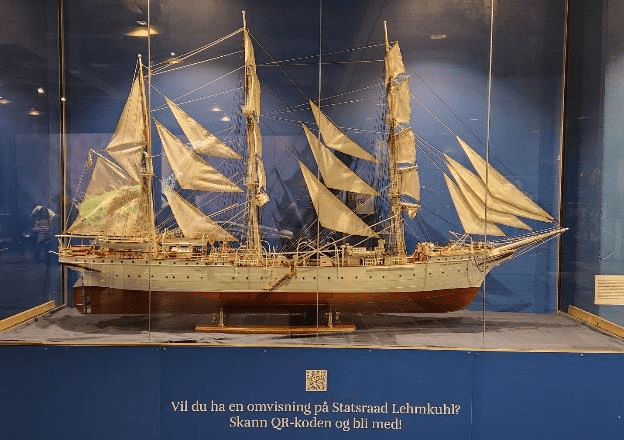
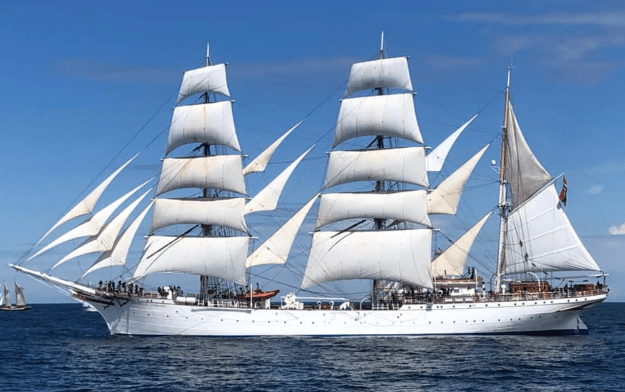
“Statsraad Lehmkuhl was built in Germany in 1914 and is one of the world’s oldest, largest and most beautiful sailing ships in operation. She has been an iconic part of Bergen’s cityscape for 100 years and is today more popular and in better condition than ever before.”
Here’s a picture of the ship under sail. I would love to sail on her.
We enjoyed this aquarium. It had a lot of signage in English, with lots of information and the tanks were clean and healthy.
After leaving the aquarium it wasn’t raining, so we decided to walk back to the Airbnb. On our walking route along the water, we passed by an old Sardine Factory that’s been renovated into several performance venues. The logo, three Auks eating sardines, remains on the building.
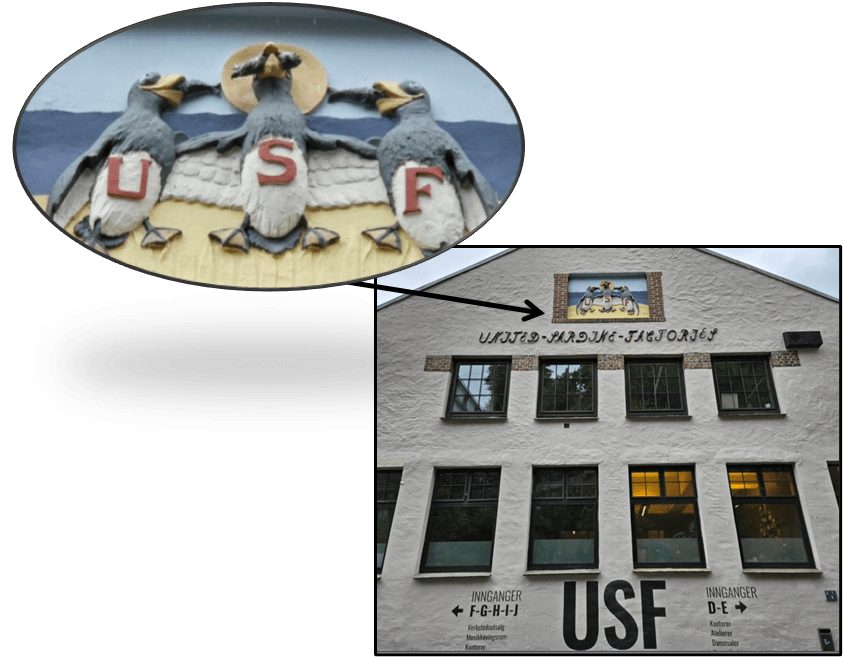
“USF is the major co-location and cluster for art, film and music and creative enterprises in Bergen and Norway. USF Verftet is a former sardine factory building accommodating five venues for presentation of music, theatre, films and contemporary art, and several artist studios and offices. USF also host the artist residency programme AiR Bergen.”
We also walked by this somewhat creepy, but interesting wall mural. I wonder what the significance of the red bracket fungus on the birch trees might be.

After returning to the Airbnb, we discussed possible things to do for our final week here in Bergen There are plenty of options.
September 19, 2023 – Tuesday: Rain and Sun
100% rain was in the forecast again for today, which is typical for Bergen. We have rain-proof clothing and gear. We don’t fear the rain!
We plan to go to the KODE Art Museums this week, but today Patti wanted time to get caught up on some things, so instead of taking in the museums, we took a walk and went by the museum ticket office to ask questions about the various museums and costs. It turns out there are four KODE museums right next to each other downtown and one ticket gets you into all four.
Another popular museum in the city is the Edvard Grieg Museum. We’ll probably go to the Grieg Museum on Wednesday, and to the other museums on Friday.
After our visit to the museum ticket desk, we stopped at a grocery store, then walked back to our Airbnb. As we walked, the rain intensified, and it started to hail! It turned out to be a chilly, rainy, full of hail walk.
By the time we returned to the apartment, the rain stopped and two men were using a drone to pressure wash the building.
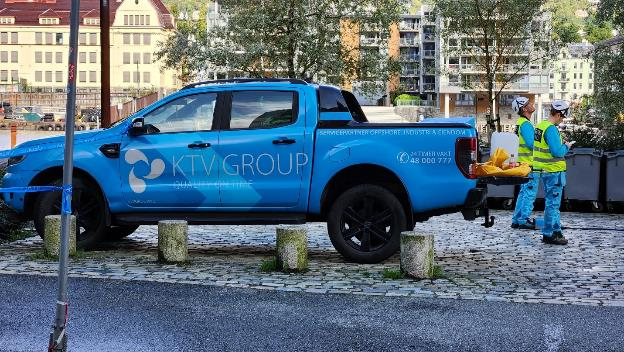
Patti got a picture of the drone outside our window.
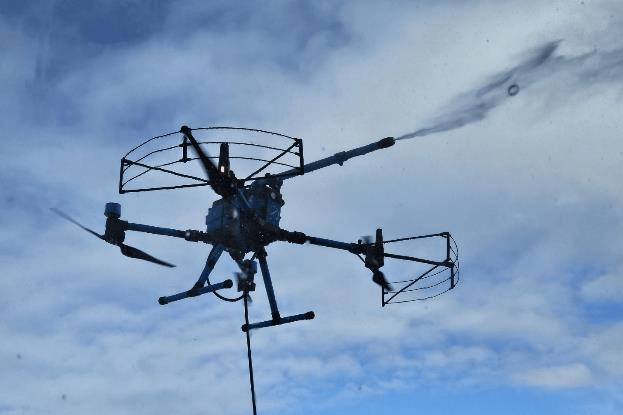
In this picture you can see the drone washing the top floor.
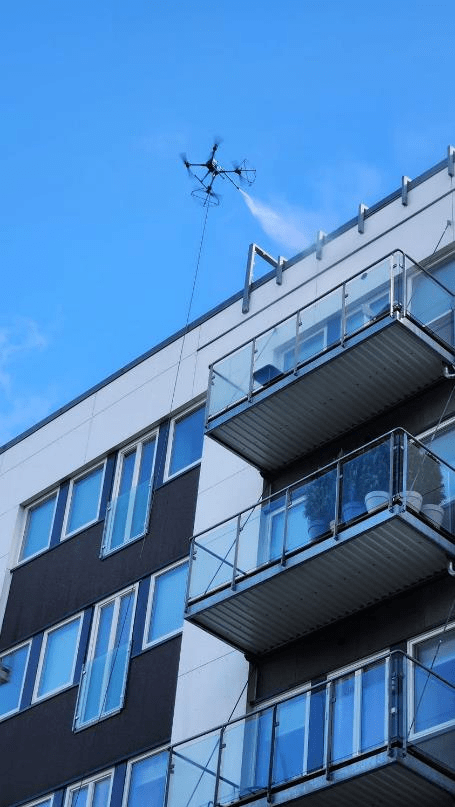
Who knew that a drone can wash windows! The pilot had excellent control of the drone. I watched him move it up and down and side to side so he could get to all the brickwork and glass panels.
The sun came out later in the afternoon, so we went out for jogs — I jog, Patti runs, of course. She says jogging is a term from the 1980s.
September 20, 2023 – Wednesday: Edvard Grieg’s House
Edvard Grieg is arguably Norway’s best known classical music composer. His house is now a museum.
“Edvard Hagerup Grieg (15 June 1843 – 4 September 1907) was a Norwegian composer and pianist. He is widely considered one of the leading Romantic era composers, and his music is part of the standard classical repertoire worldwide. His use of Norwegian folk music in his own compositions brought the music of Norway to fame, as well as helping to develop a national identity, much as Jean Sibelius did in Finland and Bedřich Smetana in Bohemia.”
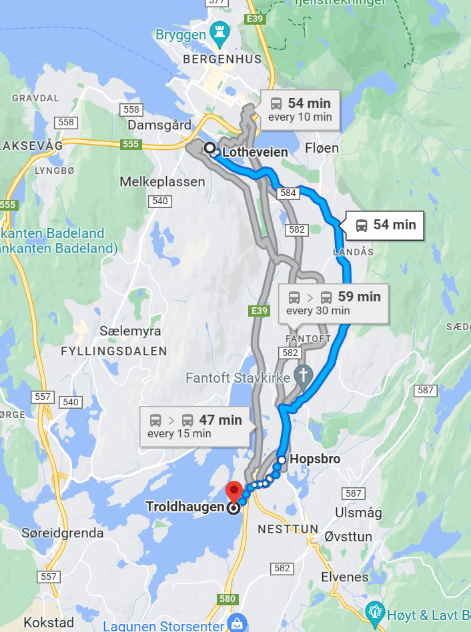
It was raining today, again, so we put on our waterproof rain pants and jackets and headed out. We took the bus about 23 stops to the town of Hop and walked to the museum from the bus stop. It was about a 20-minute walk, in the rain. Here’s the map of our route.
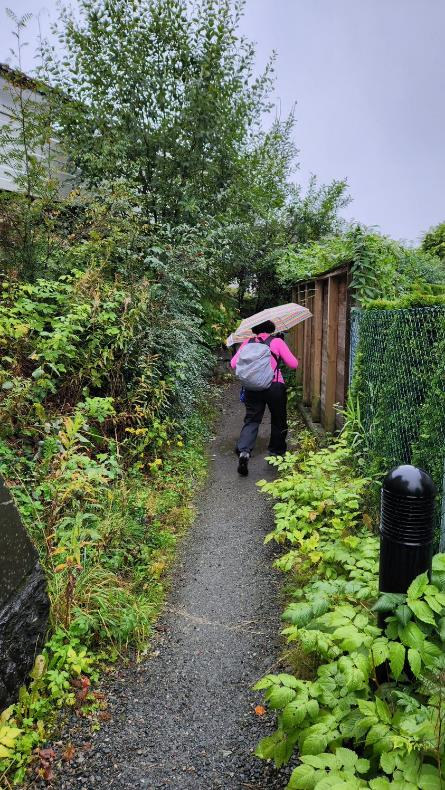
Here’s Patti on the trail. We’ve seen a lot of these pedestrian paths in Norway, they run between houses and buildings, are usually a short cut compared to walking on the roads and are very convenient.
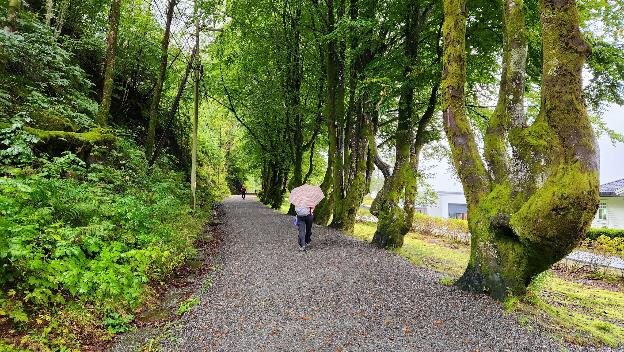
Close to the museum the path widened out and was surrounded by large moss-covered trees on the right side of the path.
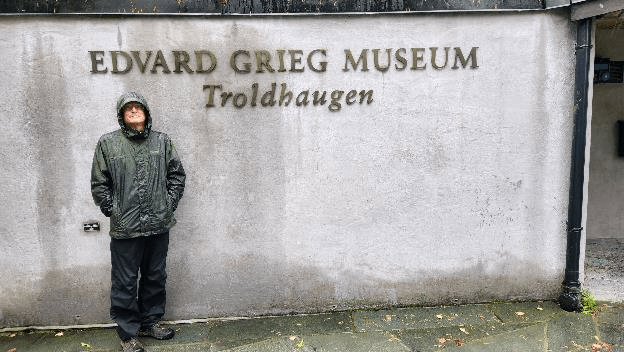
Here I am at the museum, in the rain.
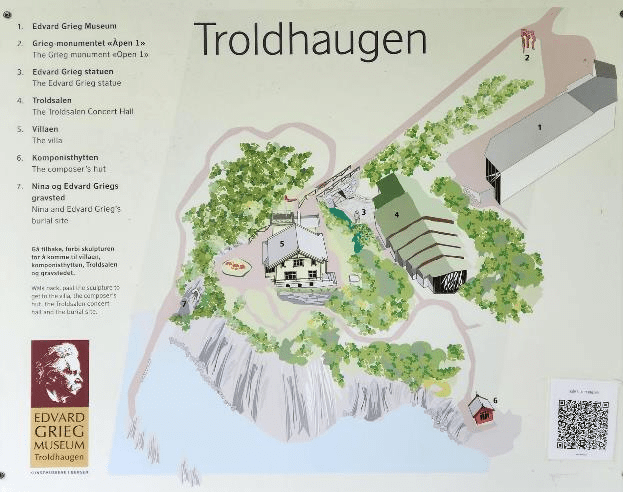
The museum is comprised of a Welcome Center with a museum and a cafe that serves Champaign (the favored drink of Edvard and Nina Grieg), Grieg’s House and his Composition Hut, a concert hall, and the burial site of Grieg and his wife Nina. Here’s the official map of the place.
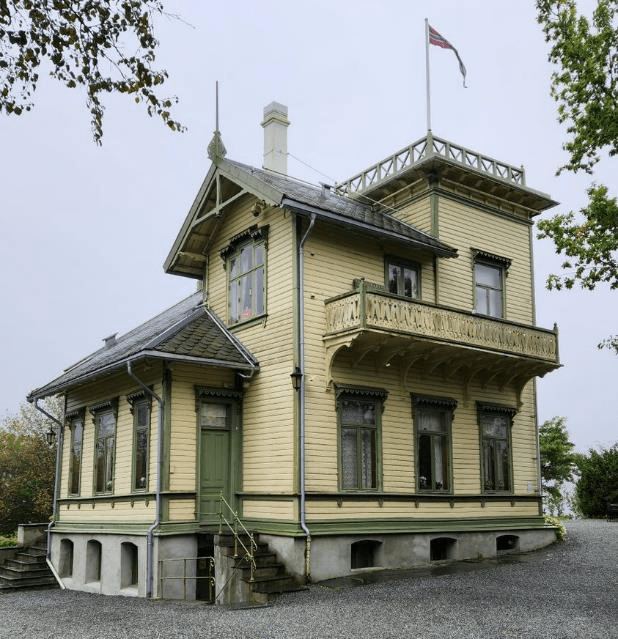
At noon we attended a group tour of the house. It’s a nice-looking old wooden house.
We were there a few minutes early, so we talked with three young men from Germany while waiting. They are from Stuttgart and are in Bergen for a week on vacation. They spoke good English and we enjoyed meeting them. It’s fun to talk to people from countries other than your own.
At noon the guide welcomed us into the house and we went into the first room, that used to be the kitchen. You can see the guide in the middle of this picture.
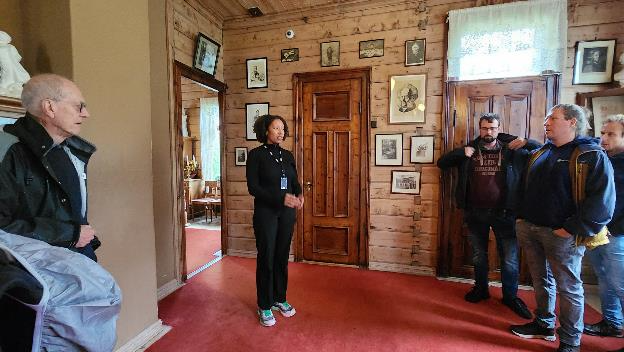
There were a lot of pictures and drawings of Grieg on the walls of this room.
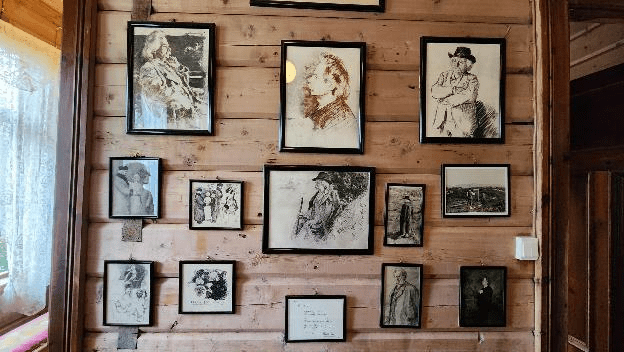
There were original manuscripts of some of Grieg’s piano pieces. Here’s the first page of “March Of The Trolls” — seeing it made me want to play it. Maybe I’ll download a pdf of it and print it so I can play it on the piano when we return to Florida later this year.

I’ve always liked seeing people’s manuscripts, in their own hand.
The dining room had more things from Grieg’s life.
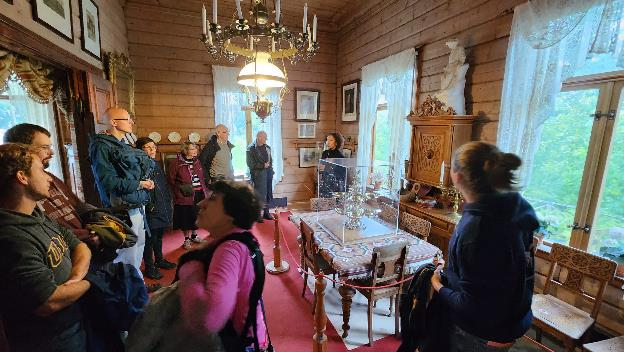
And so did the sitting room.
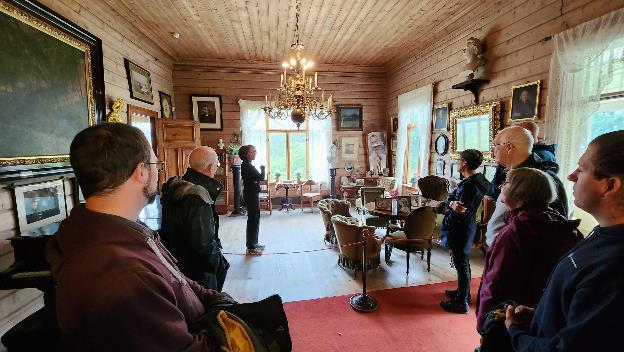
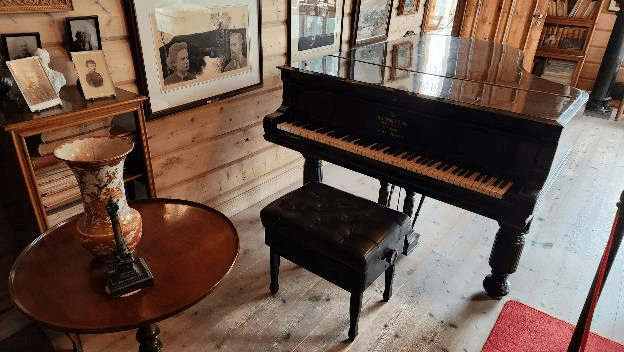
Grieg’s Steinway piano is still there.
After the house tour, we walked around the property and saw Grieg’s “Composition Hut” — it’s a bright red building.
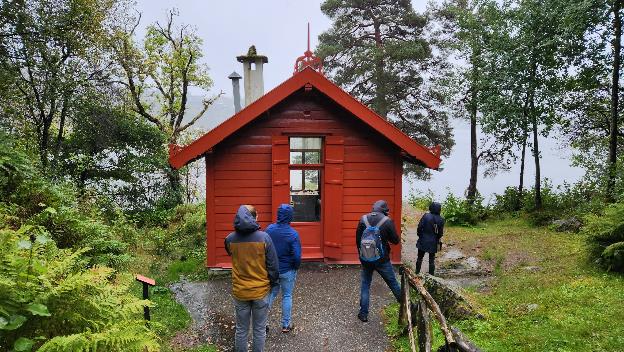
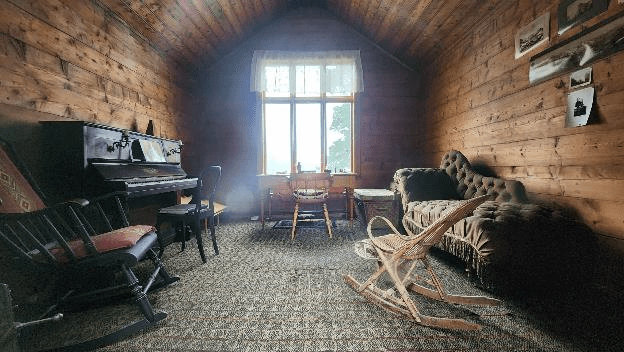
He said the big house was too noisy for him to work in so he had this hut built as a quiet place where he could compose music. It looks comfortable inside.
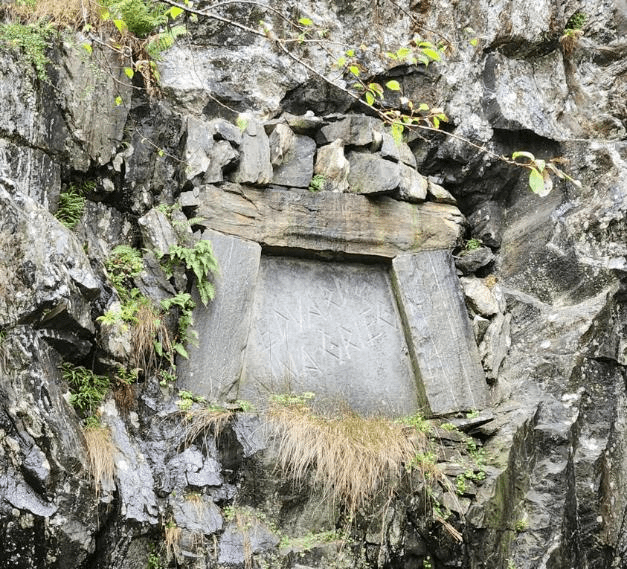
Grieg’s and his wife’s cremains are inside this crypt that he had designed by an architect.
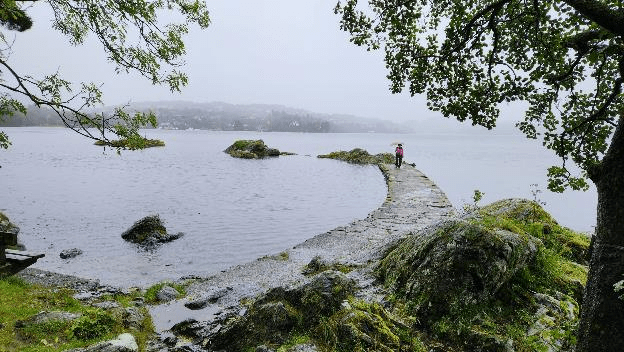
There was a concrete pier that we walked on. You can see Patti on it in this picture. It was peaceful in the drizzle.
Next, we went to the Welcome Center / Museum, where we read the timeline of Grieg’s life, saw numerous mementos and learned more about his life. There was also a history/timeline of Norway that corresponded with Grieg’s life. We enjoyed this museum.
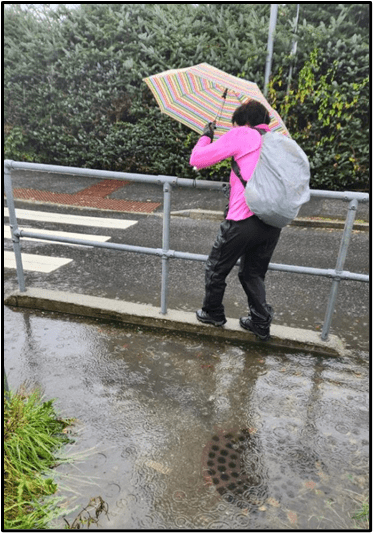
After finishing up at the museum, we decided to take the streetcar instead of the bus back to the Airbnb. On the 20-minute walk to the streetcar stop, it was still raining, and the water was fairly deep in some places. Here you can see Patti walking on the concrete curb to avoid the standing water over the manhole cover. Even though our hiking boots are waterproof, we don’t want to walk directly into puddles.
The streetcar ride was much faster than the bus. We spoke with an older Norwegian couple sitting across from us. During our conversations, we told them that we are travelling to Stockholm, Sweden next week. They informed us that the current Swedish king just celebrated his 50th year on the throne. I confirmed that when I got home.
“King Carl XVI Gustaf celebrated his golden jubilee on Friday, marking 50 years since he ascended the throne on Sept. 15, 1973.”
That is evidently big news in Scandinavia right now.
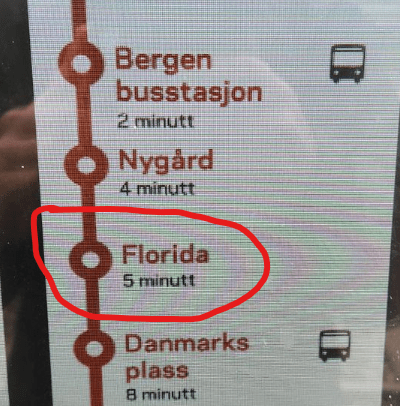
The stop we got off at is called “Florida” — this is a fun coincidence for us since we spend most of our time in Florida when we return the U.S.
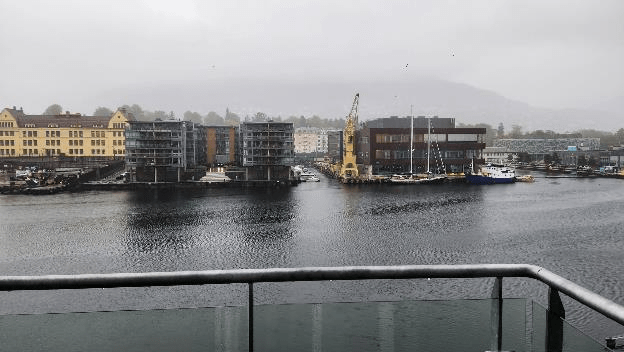
When we returned to the Airbnb, we noticed that the water level in the channel near our building was higher than we’ve ever seen it. Probably because of all the rain. From our balcony you can barely see the hill where the funicular railway is on rainy days, but I still like the view.
 2024 TRAVEL TALES