This travel update is part four of our week in Longyearbyen, Norway. It covers July 29. “Any text in quotes and Italics has been copied and pasted from some informational website like Wikipedia.”
July 29, 2023 – Saturday: The Svalbard Museum
We’ve both been a bit congested for a while and in the US I would be taking Dayquil and Nyquil and Patti would be taking Advil cold and sinus. We asked the pharmacist about getting some but she said that we needed a prescription for a decongestant! So this morning we went by the Svalbard hospital to see if it would be a simple thing just to get a prescription for something like Dayquil. But, the hospital is closed on the weekends, with an emergency phone number that you can call. So, we decided to just keep blowing our noses.
We went to the Krao restaurant for lunch and both got hamburgers and fries and they were quite good. The benches and stools in this restaurant are covered with seal skin and there were old photographs of whalers and sealers on the walls. We enjoyed the ambiance.

The Lonely Planet tour guide for Norway recommended The Svalbard Museum so we decided to do it after lunch today. We walked down main street to the museum and paid our 150 Kroner each ($15) which I thought was a bit pricey. We put covers on our boots and put our backpacks in lockers.
It is actually a nice museum with lots of stuffed examples of the wildlife in the area and lots of exhibits about the history of Svalbard.
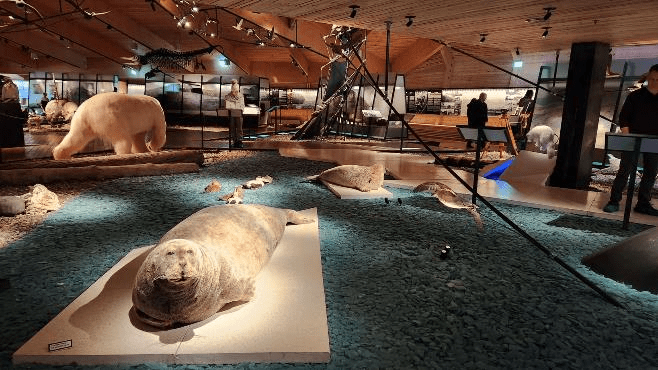
We learned that Svalbard today looks almost like a landscape from the end of the last ice age. It is mostly bare, with less than 10% vegetation, and more than half the land mass is covered by glaciers. This far north there is permafrost, and only the topsoil thaws out during the summer months. The long Arctic Night lasts for several months, the fjords freeze over and drift ice covers large areas of the surrounding sea. The temperature is low all year round, and the growing season is short. There is little food to be found except in the summer months, and a lot of the nourishment in the ecosystem comes from the rich sea around the islands.
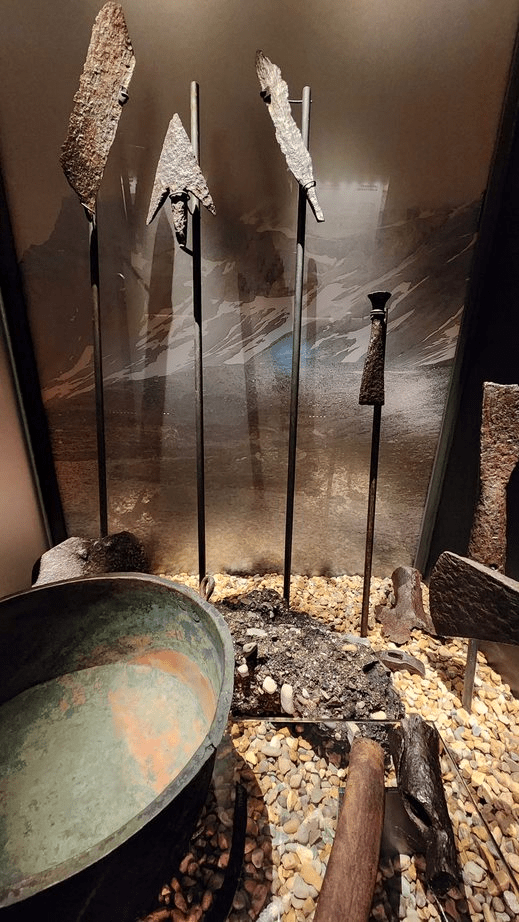
There were some implements from the early age of whaling.
This was a model of a trapper’s hut, you can see the arctic fox skins hanging on the wall and a young polar bear.
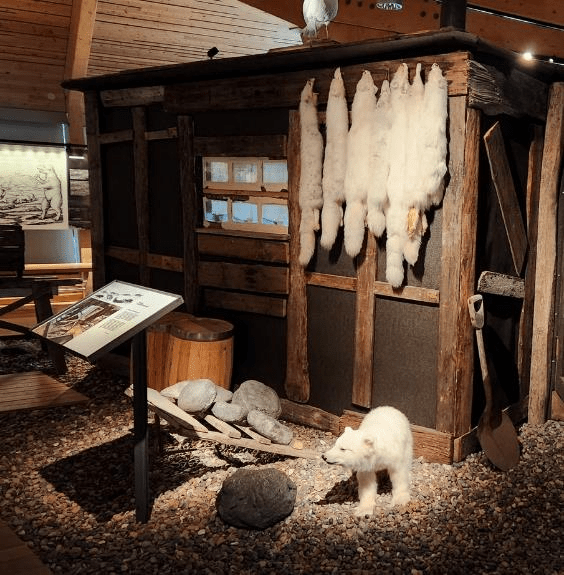
Arctic foxes must be quite adaptable to survive up here.
“The Arctic fox (Vulpes lagopus), also known as the white fox, polar fox, or snow fox, is a small fox that belongs to the family of Canidae, native to the Arctic regions of the Northern Hemisphere and common throughout the Arctic tundra biome. It is well adapted to living in cold environments, and is best known for its thick, warm fur that is also used as camouflage. It has a large and very fluffy tail. In the wild, most individuals do not live past their first year but some exceptional ones survive up to 11 years. Its body length ranges from 46 to 68 cm (18 to 27 in), with a generally rounded body shape to minimize the escape of body heat. The Arctic fox preys on many small creatures such as lemmings, voles, ringed seal pups, fish, waterfowl, and seabirds. It also eats carrion, berries, seaweed, and insects and other small invertebrates. Arctic foxes form monogamous pairs during the breeding season and they stay together to raise their young in complex underground dens. Occasionally, other family members may assist in raising their young. Natural predators of the Arctic fox are golden eagles, Arctic wolves, polar bears, wolverines, red foxes, and grizzly bears.”
These are Ptarmigan that I’ve heard about.
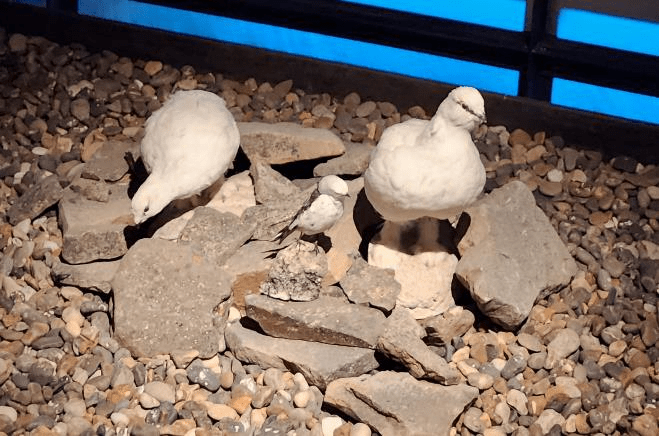
“The rock ptarmigan (Lagopus muta) is a medium-sized game bird in the grouse family. It is known simply as the ptarmigan in the UK. It is the official bird for the Canadian territory of Nunavut, where it is known as the aqiggiq, and the official game bird for the province of Newfoundland and Labrador. In Japan, it is known as the raichō (雷鳥), which means “thunder bird”. It is the official bird of Gifu, Nagano, and Toyama Prefectures and is a protected species nationwide. Unlike many arctic bird species, ptarmigan do not gain substantial mass to hibernate over winter.”
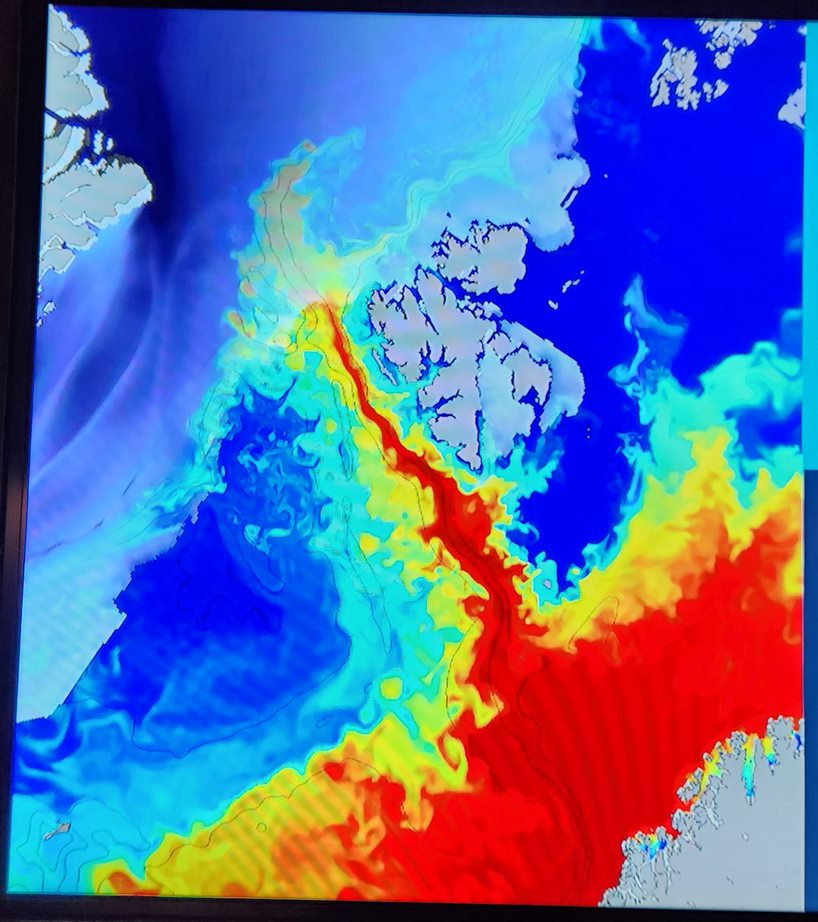
This was really interesting to me. There’s a current of warm water that curls north and runs right by the western coast of Svalbard. This makes the weather on the west coast more bearable than on the east coast. They call this a “Tropical Arctic” climate.
Here’s me with a full-size male polar bear. Polar Bears are considered to be marine mammals.
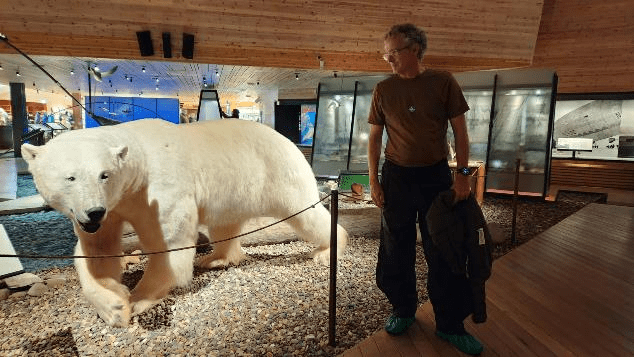
“The polar bear (Ursus maritimus) is a large bear native to the Arctic and surrounding areas. It is closely related to the brown bear, and the two species can interbreed. The polar bear is the largest extant species of bear, with adult males weighing 300–800 kg (700–1,800 lb). The species is sexually dimorphic, as adult females are much smaller. The polar bear is white- or yellowish-furred with black skin and a thick layer of fat. It is more slenderly built than the brown bear, with a narrower skull, longer neck and lower shoulder hump. Its teeth are sharper and more adapted to cutting meat. The paws are large and allow the bear to walk on ice and paddle in the water.
Polar bears are both terrestrial and pagophilic (ice-living) and are considered to be marine mammals due to their dependence on marine ecosystems. They prefer the annual sea ice, but live on land when the ice melts in the summer. They are mostly carnivorous and specialized for preying on seals, particularly ringed seals and bearded seals. Such prey is typically taken by ambush; the bear may stalk its prey on the ice or in the water, but also will stay at a breathing hole or ice edge to wait for prey to swim by. The bear primarily feeds on the seal’s energy-rich blubber. Other food includes walruses, beluga whales and some terrestrial foods. Polar bears are usually solitary with large home ranges but can be found in groups when on land. During the breeding season, male bears guard females and defend them from rivals. Mothers give birth to cubs in a maternity den during the winter, which is also when they hibernate. Young stay with their mother for up to two and a half years.”
Here’s Patti with a whale tail.
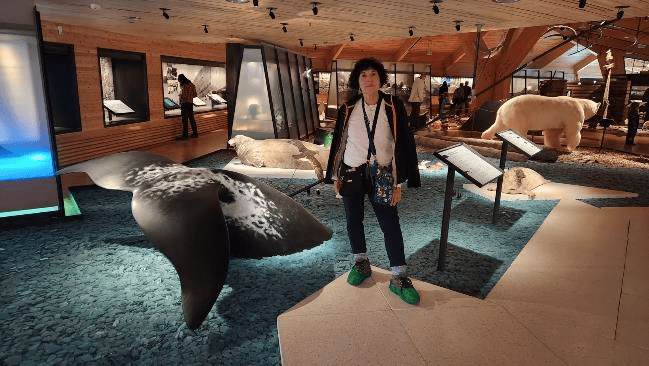
We’ve heard that the typical whales seen around Longyearbyen are Blue, Minke, Sperm, and Fin.
You can see some Svalbard reindeer here, and some geese.
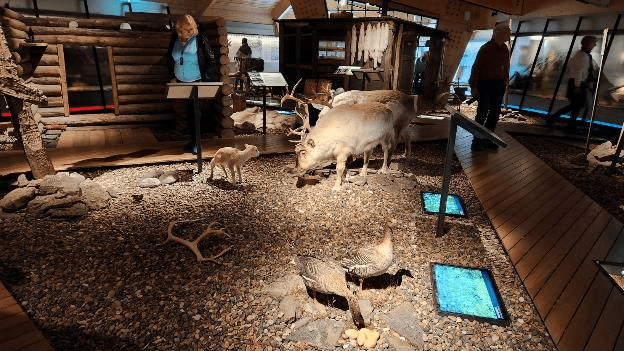
It was a nice museum and we were glad we’d been there. Especially since it drizzled all day today so we didn’t want to do anything outside.
Some takeaways for me were:
- Svalbard had a tropical climate long ago but moved north because of tectonic plate movement.
- There are fossils here from the Carboniferous Period including ferns.
- Savlbard was first discovered by a Dutchman, Willem Barentsz, around 1600.
- Various people have tried to make a living here, some by hunting and trapping.
- There have been numerous coal mines here. In Longyearbyen there are six mines that have played out but mine #7 is still operating and is still supplying coal to the electrical generating plant.
Future Plans
- We are currently staying at an Arbnb in Longyearbyen.
- August 2: We fly SAS Airlines from Longyearbyen to Tromsø.
- August 2 – 10: We reserved an Airbnb in Tomsø.
- After Tromsø, we may head south down the coast of Norway, making reservations as we travel along.
- October 17 – December 3: No plans yet.
- December 3 – 9: I will be participating in research in Durham, North Carolina, at the Med-El facilities there. Med-El is the company that made my Cochlear Implant. I’ll spend 9am to 4pm for five days being a lab rat. They say they will test various new programming options for my cochlear implant with the goal of improving their systems. It should be fun. I’m looking forward to it.
- December 9: We drive to Bradenton, Florida
- December 9 – 31: We reserved a cabin at Horseshoe Cove RV Park in Bradenton, Florida, where we stayed last year for two months (November and December). We look forward to singing in the Christmas Choir again.
2024
- January through April: We plan to travel through Belize, Costa Rica, and Panama. We don’t have reservations yet.
- May and June: We reserved a cabin at Horseshoe Cove RV Park in Bradenton, Florida. We’ll spend these two months getting our yearly medical stuff done and visiting with family and friends. May and June are “off-season” in the Sarasota / Bradenton area, and the rate is $56 per night for these 61 days, which is pretty good for a place like this in this location. In season, January through March, the price doubles.
- After June 30, we have no plans, but we are entertaining options about where to travel next summer. Maybe Germany/Austria/Switzerland.
 2024 TRAVEL TALES