This travel update is for part five of our week in Oslo, Norway. It covers our walk to the Botanical Garden on July 24.
July 24, 2023 – Monday: The Botanical Gardens
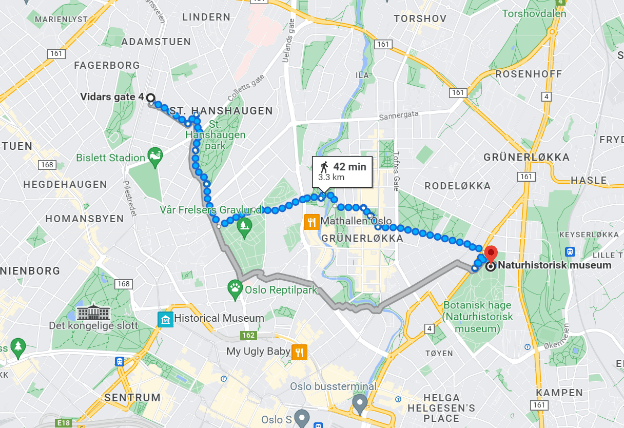
We decided to walk over to the Oslo Museum of Natural History today and see the museum and the attached botanical gardens. But, as you’ll see, we got sidetracked and skipped the museum and just saw the gardens. This happens a lot when we walk around a new city. Our route took us southeast through a part of Oslo that we hadn’t seen before.
We soon came upon this church, called the Old Aker Church, which is the oldest existing building in Oslo.
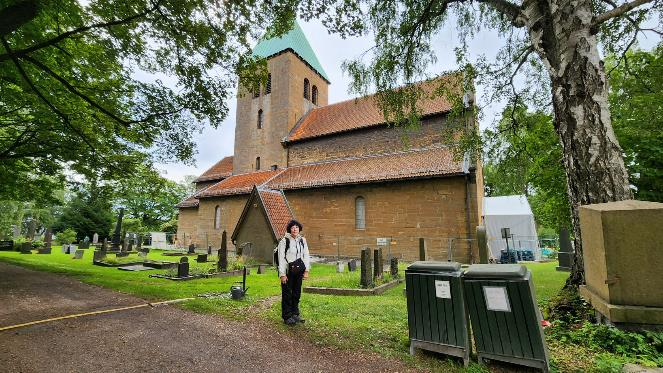
“Old Aker Church (Norwegian: Gamle Aker kirke) is a medieval era church located in Oslo, Norway. An active parish, the church is the oldest existing building in Oslo. The church is surrounded by Old Aker Cemetery. Old Aker Church was built as a three-naved Romanesque style basilica and constructed from limestone. It is believed to have been erected by King Olav Kyrre in 1080 as a church for all of Vingulmark, the historic area surrounding Oslo. The grounds of Old Aker Church were originally likely the former site of the regional thing during the pre-Christian period.”
Here we also read about the famous pilgrims path of Norway. It runs from Oslo to the Nidaros Cathedral in Trondheim which is the burial site of St. Olav, Norway’s most sacred saint.
“The Pilgrim’s Route, (Pilegrimsleden) also known as St. Olav’s Way or the Old Kings’ Road, was a pilgrimage route to the Nidaros Cathedral in Trondheim, Norway, the site of the medieval tomb of St. Olav. The main route is approximately 640 kilometres (400 mi) long. It starts in the ancient part of Oslo and heads north along the lake Mjøsa, up the Gudbrandsdal valley, over the Dovrefjell mountains, and down the Oppdal and Gauldalen valleys to end at the Nidaros Cathedral.”
It would be fun to walk that path, in the summer, if there were comfortable guest houses to stay at along the way every night, with hot running water and soft beds, and tasty food. I don’t think I’d like camping out on the ground, not even in the summer.
The adjacent cemetery was very pretty, with well-tended plots and planted flowers.
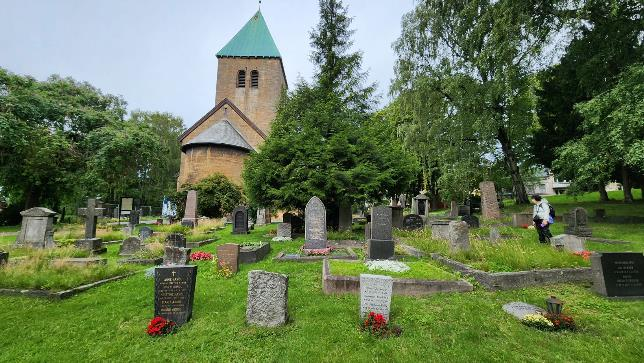
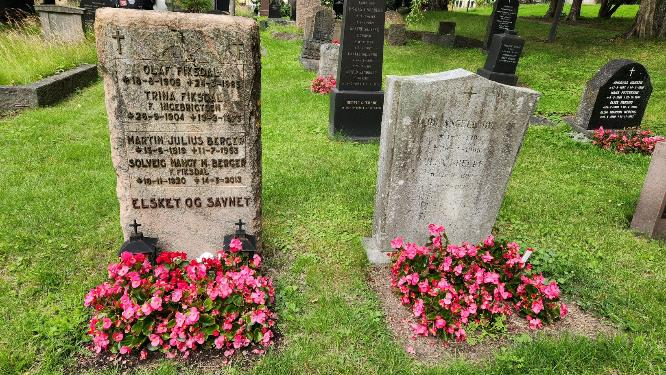
We spent about 30 minutes walking around the grounds. It’s on a hill so we had a nice view of Oslo to the south and it was very quiet and peaceful in contrast to the tourist areas of the city that we’ve mostly been in.
Continuing our walk we passed by manhole covers with this logo on them.
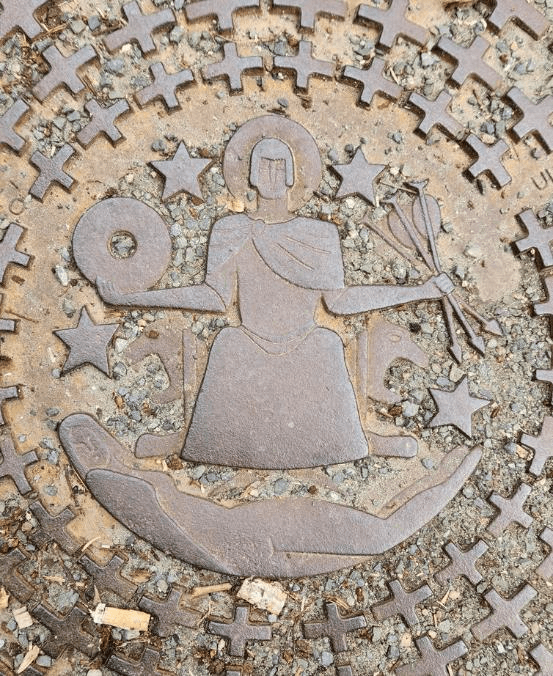
It turns out to be the official logo of Oslo.
“The revamped logo is a simplified line drawing of a highly detailed art deco-style logo designed in 1928, which shows the patron saint of Oslo, Saint Hallvard. Hallvard Vebjørnsson (Hallvard Den Hellige) (c. 1020–1043), commonly referred to as Saint Hallvard (Sankt Hallvard), is the patron saint of Oslo. He is considered a martyr because of his defense of an innocent thrall woman. His religious feast day is 15 May. The connection of St. Hallvard to the city of Oslo was evidenced by the fact that his image was recorded in the city’s seal since the Middle Ages. The municipality’s highest honor, the St. Hallvard Medal (St. Hallvard-medaljen), was named after him in 1950. Saint Hallvard is depicted in the seal of the city of Oslo, holding the millstone and arrows used to kill him, with the woman he defended at his feet.”
We soon got to the Akerselva, a river that was once the dividing line between town and country. It has always been the main conduit for sewage and industrial waste in Oslo. That’s not exactly a huge plus but I’ve read that every city back then had to use a river for sewage and waste, they had to get rid of if somehow and couldn’t think of anything else to do with it. Industry grew up around the river, since it was industry that needed the river for power for production and as a place to dispose of the waste. There has been production around Akerselva for 1,000 years, up until the 1980s.
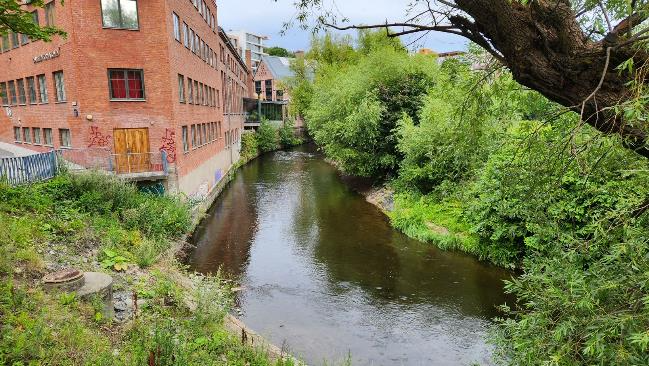
These days it looks nice, it didn’t smell bad and we saw almost no garbage. They must have cleaned it up.
It was along this river that we found a nice food court, the Mathallen Oslo, and, since it was lunch time, we went in.
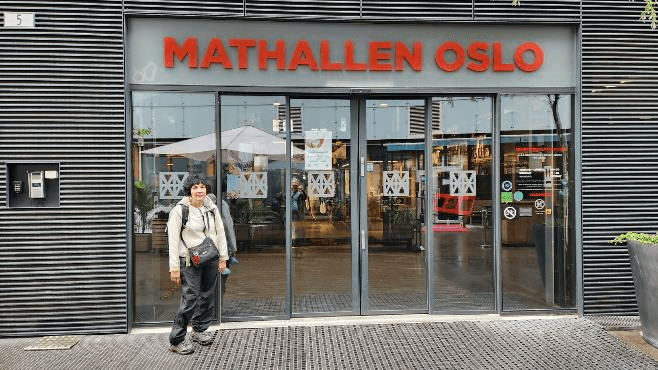
It was a large, popular venue crowded with people.
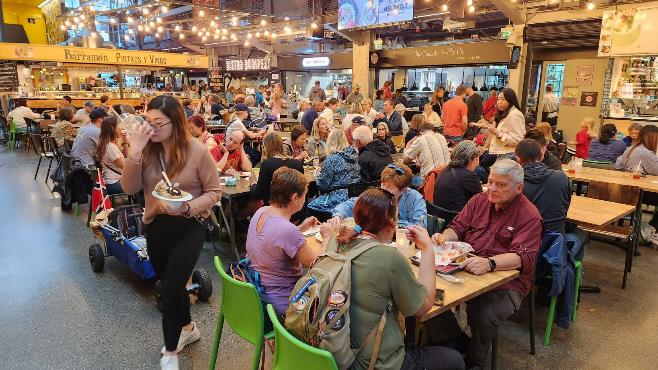
I got some Hong Kong wonton noodle soup and Patti got a hamburger. After lunch we walked back over the bridge over the river and I saw this concrete structure that I guessed was a fish ladder for salmon.

I’ve heard of these before but never seen one. It had many levels and probably helps the salmon bypass the adjacent manmade waterfall.
By the time we got to the Natural History Museum it was 2 PM and the museum closes at 5, and it costs $10 to get in. You see how we get sidetracked? So, we decided to skip the museum, save it for next time we’re in Oslo, and just walk around the botanical gardens which are part of the museum grounds but which are free.
And it was a very nice botanical garden. There were lots of flowers.
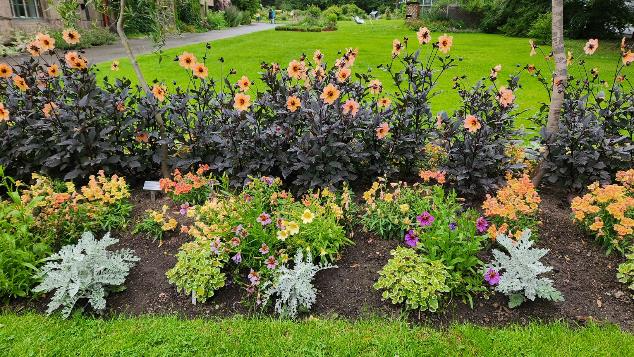
It started raining around 2 o’clock, as we were starting to walk through the gardens, so we had our rain gear on.

This lily pond with a willow tree was very pretty.
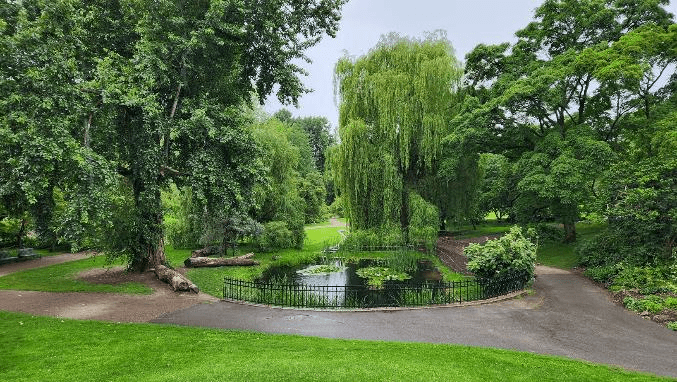
There were quite a few people out walking around the gardens so maybe 60 degrees F and drizzling is decent summer weather in Oslo.
There were two greenhouses. The first one, Victoria House, was constructed in 1876 to house the giant Amazon water lily, Victoria cruziana, which is named after the British Queen Victoria.
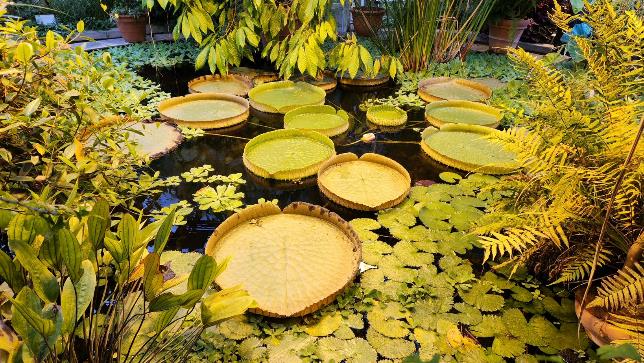
This emulates a similar greenhouse that was at the Crystal Palace during the World Exposition in London in 1851 in Hyde Park. That was interesting to me, that the Norwegians wanted to have a similar greenhouse in Oslo to the one they saw in London.
The greenhouse also had some carnivorous plants, which I always enjoy seeing, like this Pitcher Plant.
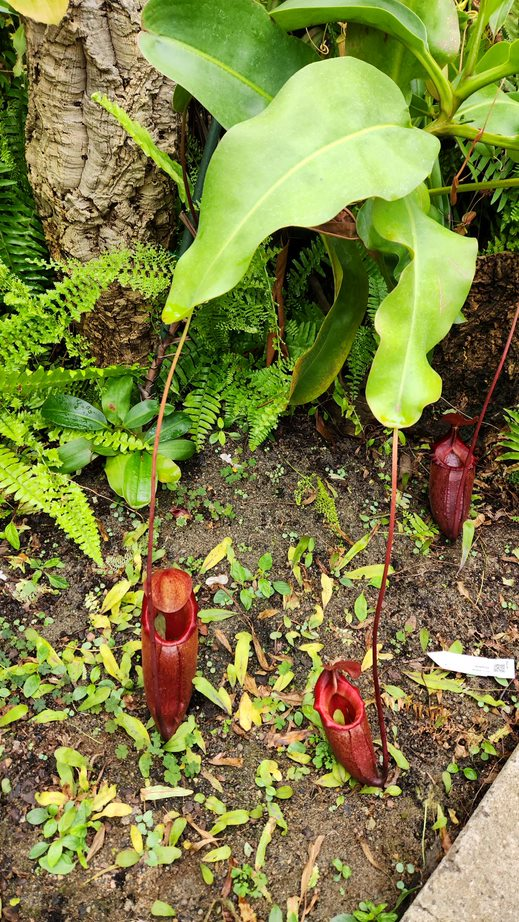
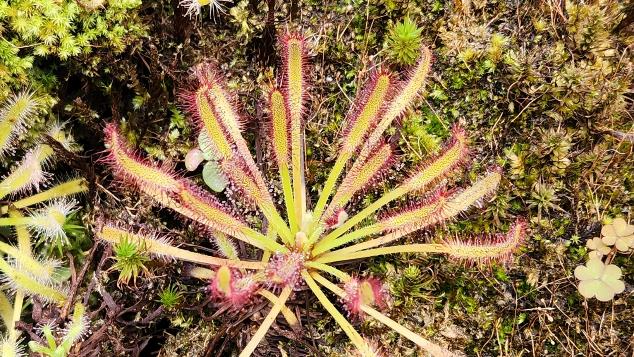
And this Sundew.
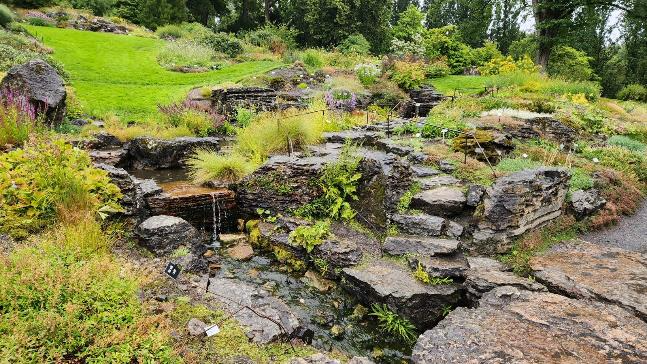
There was a very pretty rock garden that was quite large and had a stream flowing through it.
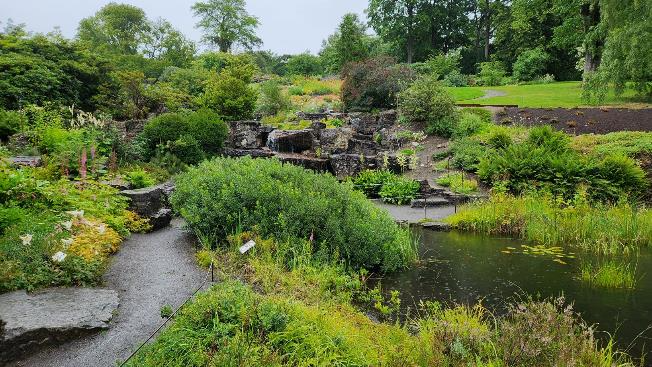
At the bottom of the rock garden was another lily pond with a small waterfall.
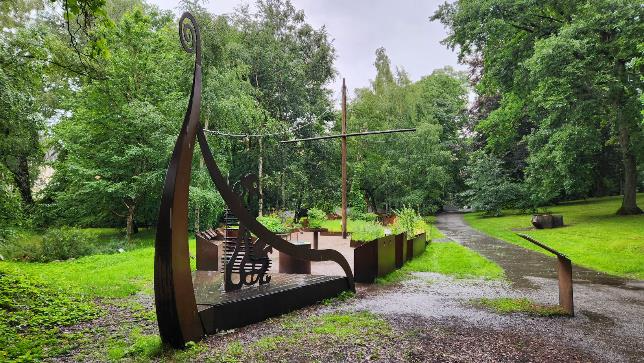
The children’s play area was shaped like a Viking ship, I thought that was cool.
So, to sum up the day, we didn’t get to the Museum of Natural History, but we did see some really pretty and interesting stuff.
Future Plans
- July 18 – 26: We are currently staying at an Airbnb reservation in Oslo.
- July 27: We fly Norwegian Airlines from Oslo to Longyearbyen.
- July 27 – August 2: We reserved an Airbnb in Longyearbyen.
- August 2: We fly SAS Airlines from Longyearbyen to Tromsø.
- August 2 – 10: We reserved an Airbnb in Tomsø.
- We are thinking that after Tromsø, we will head south down the coast of Norway, making reservations as we travel along.
- October 17 – December 3: No plans yet.
- December 3 – 9: I will be participating in research in Durham, North Carolina, at the Med-El facilities there. Med-El is the company that made my Cochlear Implant. I’ll spend 9am to 4pm for five days being a lab rat. They say they will test various new programming options for my cochlear implant with the goal of improving their systems. It should be fun. I’m looking forward to it.
- December 9: We drive to Bradenton, Florida
- December 9 – 31: We reserved a cabin at Horseshoe Cove RV Park in Bradenton, Florida, where we stayed last year for two months (November and December). We look forward to singing in the Christmas Choir again.
2024
- January through April: We plan to travel through Belize, Costa Rica, and Panama. We don’t have any reservations yet.
- May and June: We reserved a cabin at Horseshoe Cove RV Park in Bradenton, Florida. We’ll spend these two months getting our yearly medical stuff done and visiting with family and friends. May and June are “off-season” in the Sarasota / Bradenton area, and the rate is $56 per night for these 61 days, which is pretty good for a place like this in this location. In season, January through March, the price doubles.
- After June 30, we have no plans, but we are entertaining options about where to travel next summer. Maybe Germany/Austria/Switzerland?
 2024 TRAVEL TALES