This travel update is for part one of our week in Oslo, Norway. It covers just one day, July 19, which was our traditional “walk around the city” day. We usually do this on our first day in a new city.
Note: “Any text in quotes and Italics has been copied and pasted from some informational website like Wikipedia.”
July 19, 2023 – Wednesday (Woden’s Day): A Walking Tour of Oslo
Many of our American days of the week are named for Norse Gods, such as Wednesday, which is named for Odin, father of the Gods.
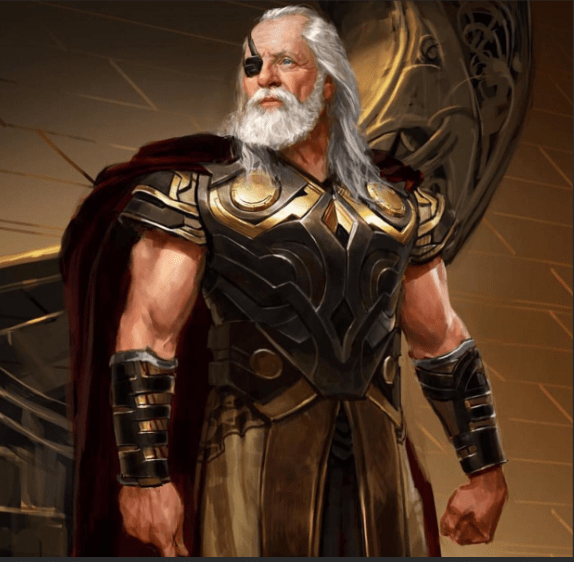
“In English, the name is derived from Old English Wōdnesdæg and Middle English Wednesdei, ‘day of Woden’, reflecting the religion practiced by the Anglo-Saxons, the English equivalent to the Norse god Odin.”
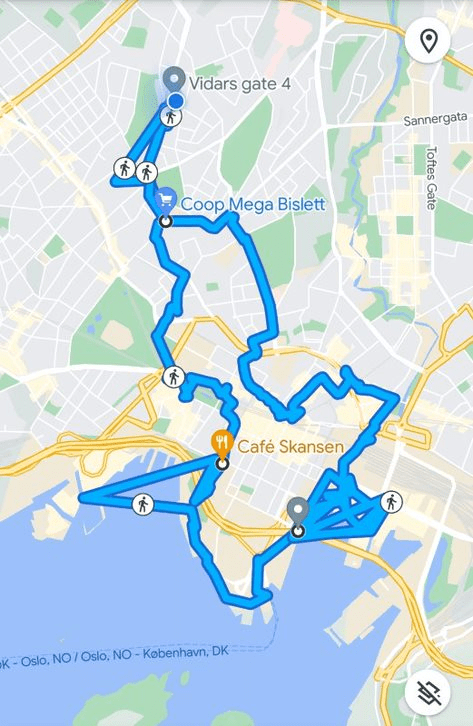
Today we decided to walk down to the opera house and back. When we do this kind of a walk we wander and just basically see what we can see. We knew there would be a lot of interesting things to see. On the map below you can see Vidars Gate 4 which is where we’re living these days. We walked south and made kind of a loop on our walk today. It was about a 10 mile walk.
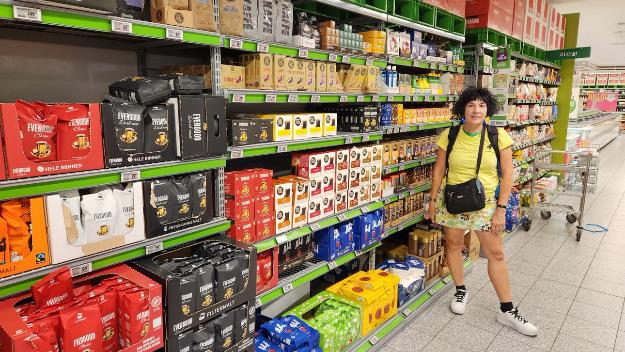
While still in our neighborhood we checked out some local grocery stores and pharmacies. Here’s Patti in one of the coffee aisles.
And here she is in a drug store / pharmacy.
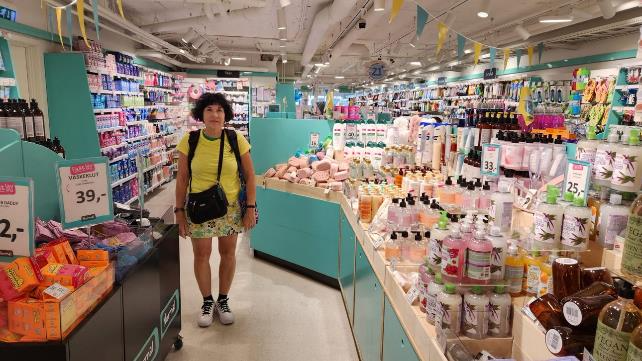
That may seem mundane but it’s helpful to know what’s available locally.
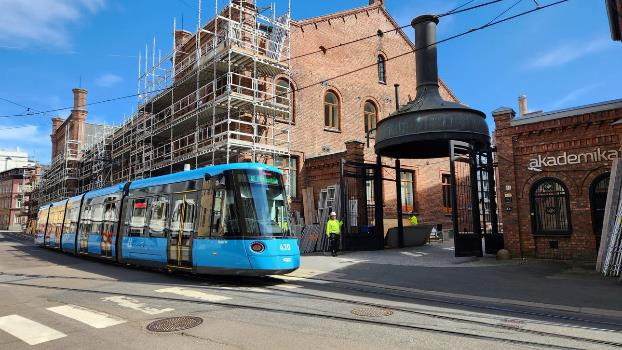
We passed a university whose façade was being renovated. I liked the big metal thing over their entrance gate that looks like the top of a big vat. The blue tram is the one we rode yesterday.
We walked by the Royal Palace where there were lots of people enjoying the park.
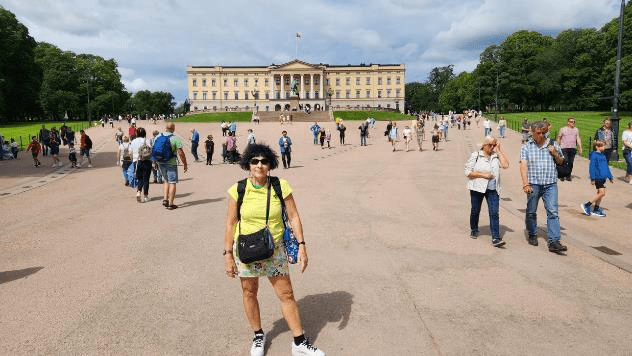
“The Royal Palace in Oslo was built in the first half of the 19th century as the Norwegian residence of the French-born King Charles III John, who reigned as king of Norway and Sweden. The palace is the official residence of the current Norwegian monarch while the Crown Prince resides at Skaugum in Asker west of Oslo.
The palace is located at the end of Karl Johans gate in central Oslo and is surrounded by the Palace Park with the Palace Square in the front.”
The National Theater was impressive.
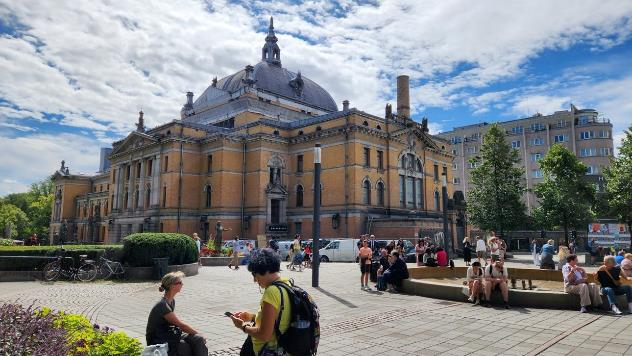
“The National Theatre in Oslo is one of Norway’s largest and most prominent venues for performance of dramatic arts. The theatre had its first performance on 1 September 1899 but can trace its origins to Christiania Theatre, which was founded in 1829. There were three official opening performances, on subsequent days in September: first, selected pieces by Ludvig Holberg, then An Enemy of the People by Henrik Ibsen, and on the third day Sigurd Jorsalfar by Bjørnstjerne Bjørnson.”
The façade and pediment pay homage to famous Norwegians of the theater.
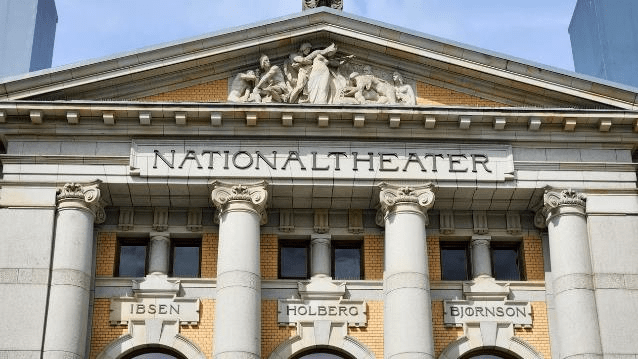
Here I am with Henrik Ibsen, a famous Norwegian playwright.
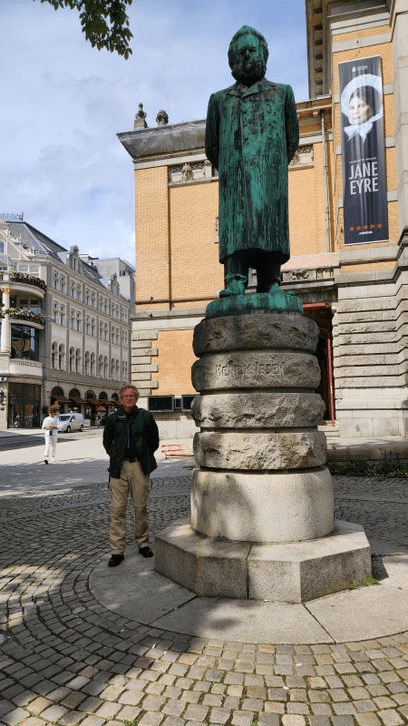
“Henrik Johan Ibsen (/ˈɪbsən/;[1] Norwegian: [ˈhɛ̀nrɪk ˈɪ̀psn̩]; 20 March 1828 – 23 May 1906) was a Norwegian playwright and theatre director. As one of the founders of modernism in theatre, Ibsen is often referred to as “the father of realism” and one of the most influential playwrights of his time. His major works include Brand, Peer Gynt, An Enemy of the People, Emperor and Galilean, A Doll’s House, Hedda Gabler, Ghosts, The Wild Duck, When We Dead Awaken, Rosmersholm, and The Master Builder. Ibsen is the most frequently performed dramatist in the world after Shakespeare, and A Doll’s House was the world’s most performed play in 2006.”
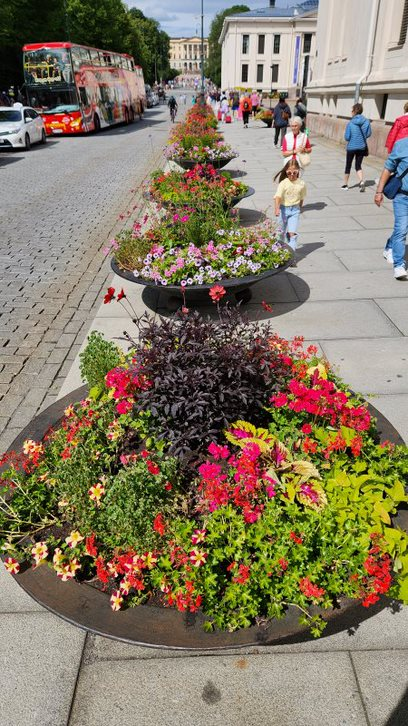
There were lots of pretty flowers in the landscaping along our route.
The Parliament building, also called the Storting building, was cool looking.
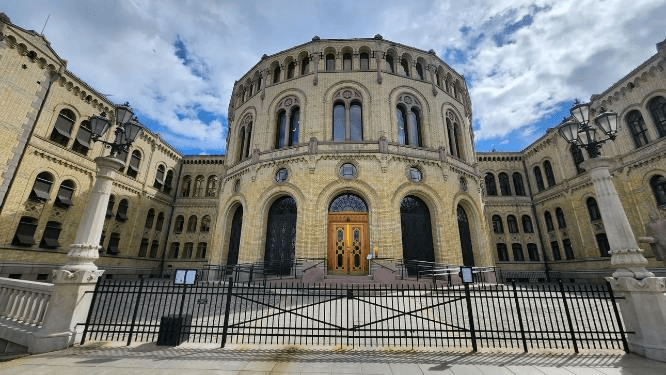
“The Storting (‘the Great Thing’) is the supreme legislature of Norway, established in 1814 by the Constitution of Norway. It is located in Oslo. The unicameral parliament has 169 members and is elected every four years based on party-list proportional representation in nineteen multi-seat constituencies. A member of Stortinget is known in Norwegian as a stortingsrepresentant, literally “Storting representative”.”
We stopped for lunch at an outdoor restaurant that serves Norwegian food.
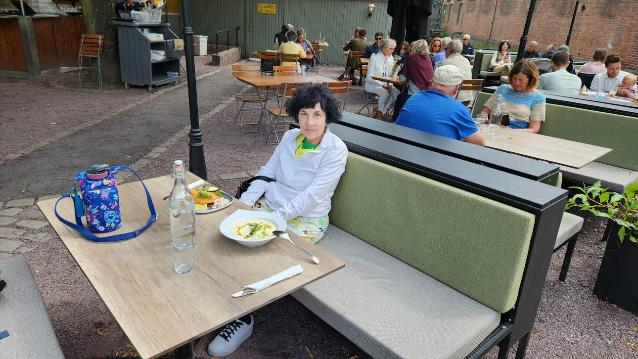
I got the Kremet Fiskesuppe.
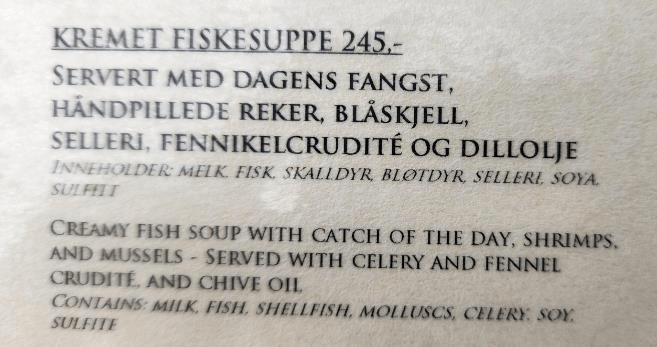
It was really good, I liked the flavors, except for the mussels. I’ve never eaten mussels before but decided to try them today and I didn’t like their flavor much. Here I am with a mussel. I know they’re very popular in lots of places, but I’m going to keep avoiding them.
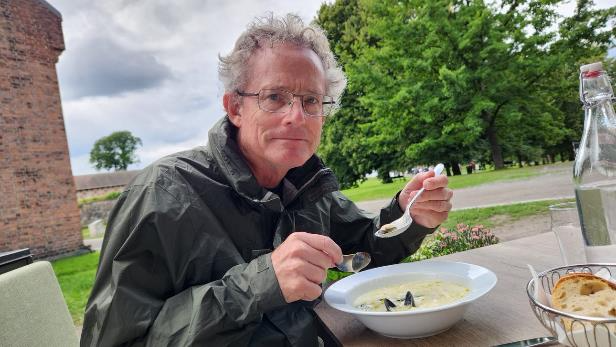
Total cost of the meal including tip was $54.93 USD. Expensive by our standards, Oslo has been living up to its reputation as an expensive city. But I like trying local food.
We walked by the old fortress down at the waterfront.
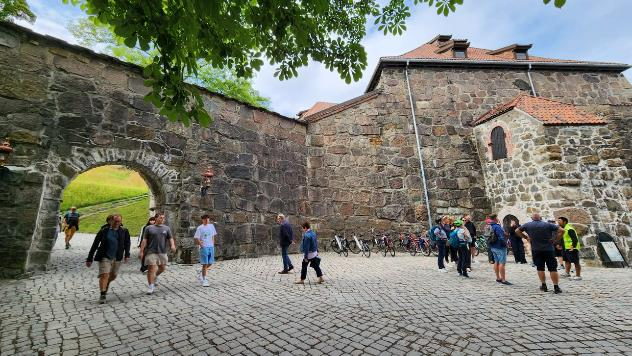
“Akershus Fortress is a medieval castle in the Norwegian capital Oslo that was built to protect and provide a royal residence for the city. Since the Middle Ages the fortress has been the namesake and centre of the main fief and later main county of Akershus, which was originally one of Norway’s four main regions and which included most of Eastern Norway. The fortress itself was located within the Akershus main county until 1919, and also within the smaller Akershus sub county until 1842. The castle has also been used as a military base, a prison and is currently the temporary office of the Prime minister of Norway.”
There was a nice view of the harbor from the battlements and there were lots of cruise ships, ferries, and private boats.
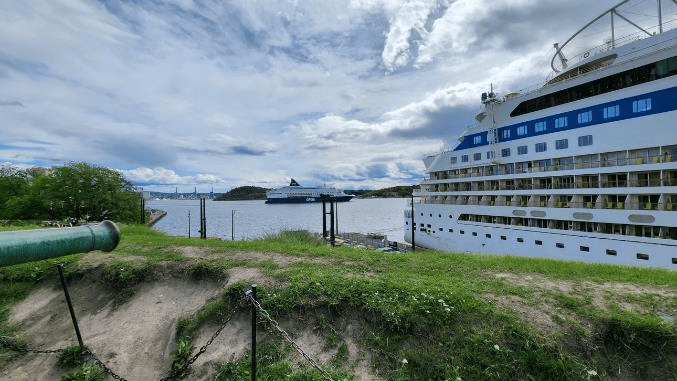
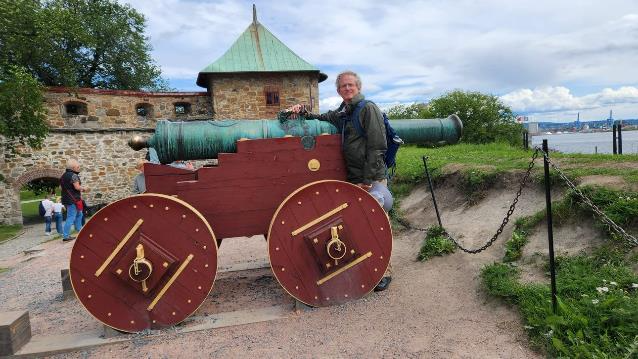
I liked this canon with the cool carriage with big wheels.
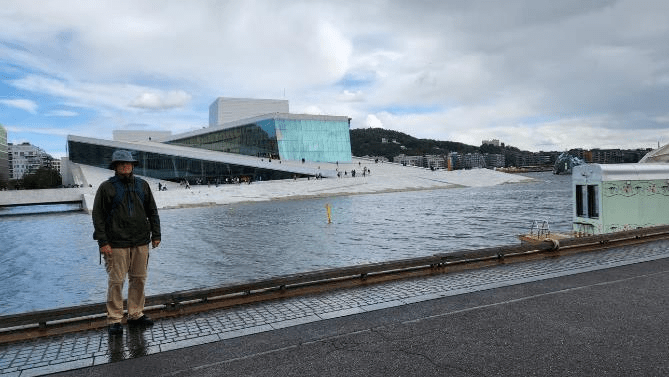
After that we walked along the water to the Oslo Opera House which is a big attraction here. It was drizzling at this point so I had my waterproof windbreaker on and pulled my hat low.
And here I am with a famous Norwegian opera singer.
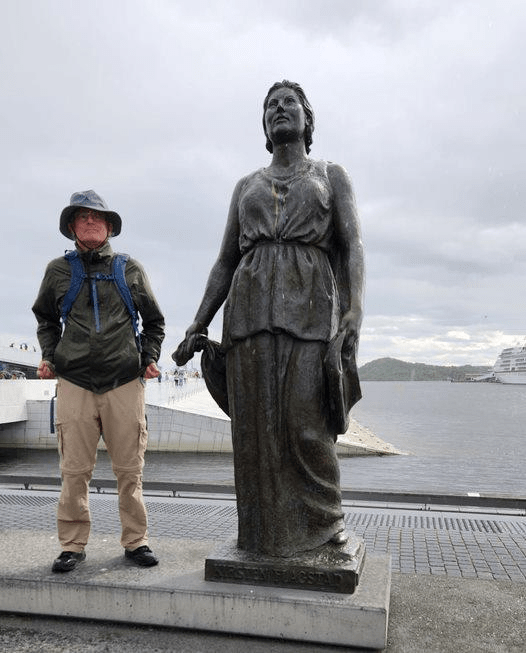
“Kirsten Malfrid Flagstad (12 July 1895 – 7 December 1962) was a Norwegian opera singer, who was the outstanding Wagnerian soprano of her era. Her triumphant debut in New York on 2 February 1935 is one of the legends of opera. Giulio Gatti-Casazza, the longstanding General Manager of the Metropolitan Opera said, “I have given America two great gifts — Caruso and Flagstad”.”
We got our selfie from the roof of the opera house.
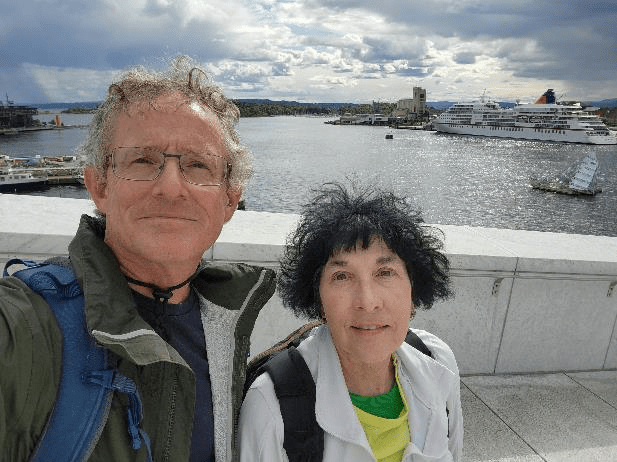
“The Oslo Opera House (Norwegian: Operahuset) is the home of the Norwegian National Opera and Ballet, and the national opera theatre in Norway. The building is situated in the Bjørvika neighbourhood of central Oslo, at the head of the Oslofjord. It is operated by Statsbygg, the government agency which manages property for the Norwegian government. The structure contains 1,100 rooms in a total area of 49,000 m2 (530,000 sq ft). The main auditorium seats 1,364 and two other performance spaces can seat 200 and 400. The main stage is 16 m (52 ft) wide and 40 m (130 ft) deep. The angled exterior surfaces of the building are covered with marble from Carrara, Italy and white granite and make it appear to rise from the water. It is the largest cultural building constructed in Norway since Nidarosdomen was completed circa 1300.”
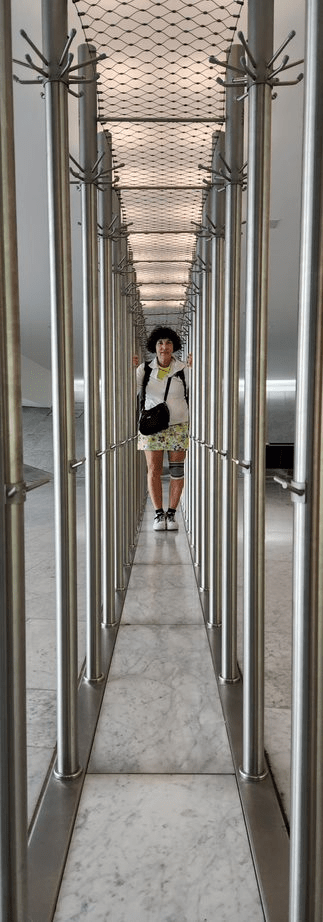
The interior design is cool looking, here’s Patti in part of the hat rack.
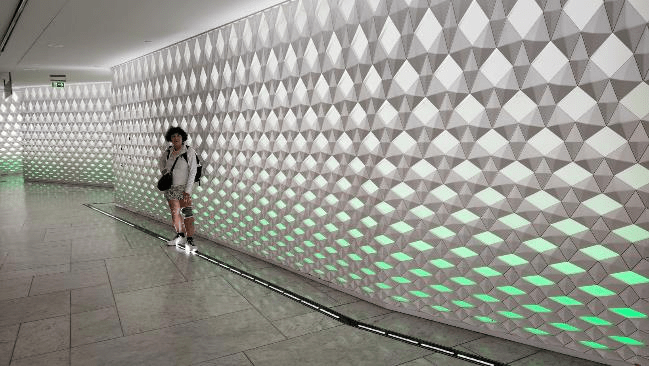
And here she is against one of the interior walls.
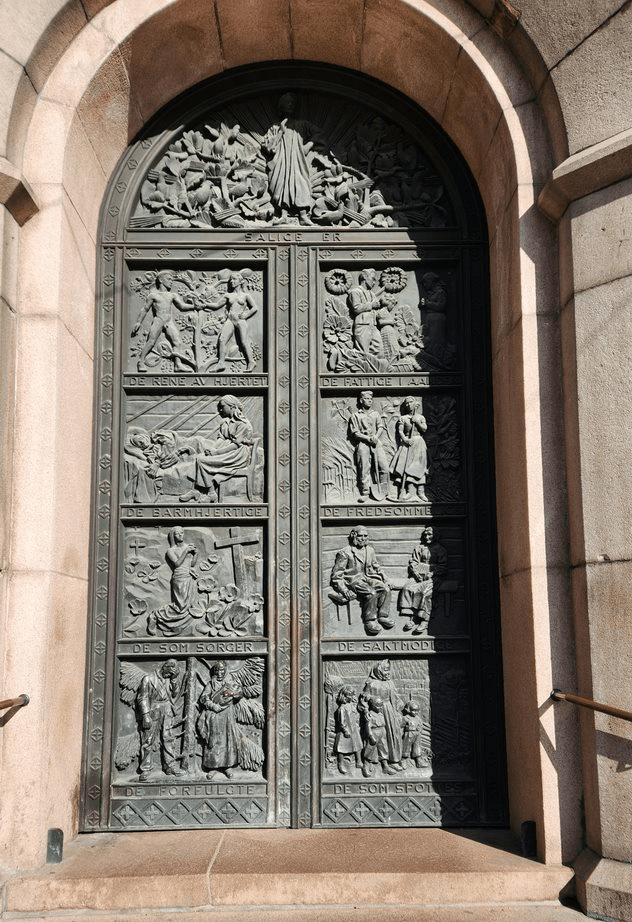
We walked by the Oslo Cathedral which has a nice front door with scenes from the bible in bronze.
We walked by the statue of King Christian IV who is quite well known around here.
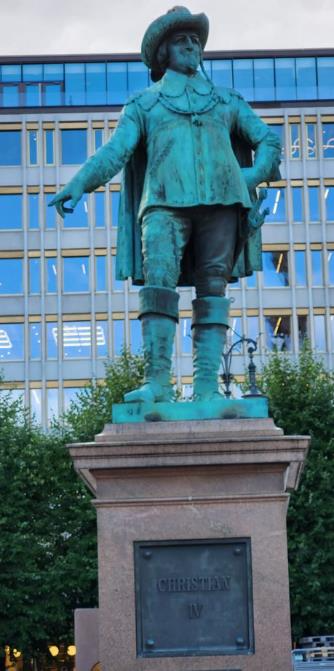
“Christian IV (12 April 1577 – 28 February 1648) was King of Denmark and Norway and Duke of Holstein and Schleswig from 1588 until his death in 1648. His reign of 59 years, 330 days is the longest of Danish monarchs and Scandinavian monarchies. A member of the House of Oldenburg, Christian began his personal rule of Denmark in 1596 at the age of 19. He is remembered as one of the most popular, ambitious, and proactive Danish kings, having initiated many reforms and projects. Christian IV obtained for his kingdom a level of stability and wealth that was virtually unmatched elsewhere in Europe. He engaged Denmark in numerous wars, most notably the Thirty Years’ War (1618–1648), which devastated much of Germany, undermined the Danish economy, and cost Denmark some of its conquered territories. He rebuilt and renamed the Norwegian capital Oslo as Christiania after himself, a name used until 1925.”
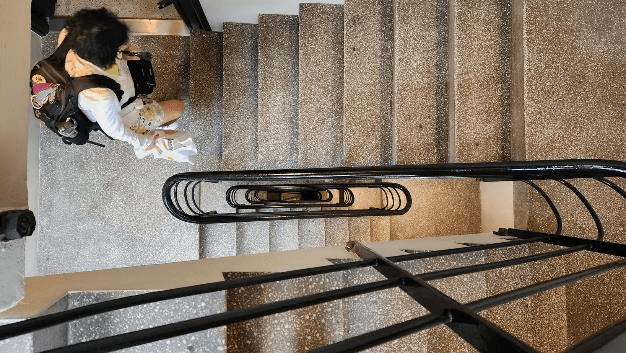
We walked on back home after that, here’s Patti coming up the five flights of stairs in our building. With only our small backpacks it’s not a bad climb.
Future Plans:
- July 18 – 26: We’ve got Airbnb reservations at an Airbnb in Oslo
- July 27: We’re flying Norwegian Airlines from Oslo to Longyearbyen.
- July 27 – August 2: We’ve got an Airbnb reservation for a place in Longyearbyen.
- August 2: We have flight reservations on SAS to go from Longyearbyen to Tromsø.
- August 2 – 10: We have an Airbnb reservation for a place in Tomsø.
- We’re thinking that after Tromsø we’ll head south down the coast of Norway. We’ll make reservations as we go.
- October 17 – December 3: No plans yet.
- December 3 – 9: I’ll be participating in research in Durham, North Carolina at the Med-El facilities there. Med-El is the company that made my cochlear implant and they’re going to put us up in a hotel and I’ll spend 9AM to 4PM for 5 days that week being a lab rat. They say they will test various new programming options for my cochlear implant with the goal of improving their systems. It should be fun, I’m looking forward to it.
- December 9: We’ll drive to Bradenton, Florida
- December 9 – 31: We’ve reserved a cabin at Horseshoe Cove RV Park in Bradenton, Florida, where we stayed last year around this time. We’re looking forward to singing in the Christmas Choir again.
2024
- January through April: We plan to travel through Belize, Costa Rica, and Panama. We don’t have any reservations yet.
- May and June: We’ve reserved a cabin at Horseshoe Cove RV Park in Bradenton, Florida again and we’ll spend these two months getting our yearly medical stuff done and visiting with family and friends. May and June are “off-season” here, and the rate is $56 per night for these 61 days, which is pretty good for a place like this in this location. In season, January through March, the price doubles.
- After June 30, we have no plans, but we’re entertaining options about where to travel next summer. Maybe Germany/Austria/Switzerland?
 2024 TRAVEL TALES